Application scope
- Beverages requiring enhanced filling environment hygiene and packaging treatment.
- PET production lines seeking to reduce the post-blow transfer path for sensitive formulations.
Integrated Combiblock Systems
The ultra-clean combiblock system provides enhanced hygienic control for sensitive beverage lines by minimizing post-blow conveying paths, upgrading container and cap treatment, isolating the filling zone with filtered airflow, and ensuring cleanable equipment boundaries.
Project fit snapshot
Suitability depends on the product, container, output, hygienic route and connected equipment. Conditions outside the published scope require engineering review.
Technical content: fourth editionRequest relevant project records and configuration evidence during engineering review.
The ultra-clean combiblock system provides enhanced hygienic control for sensitive beverage lines by minimizing post-blow conveying paths, upgrading container and cap treatment, isolating the filling zone with filtered airflow, and ensuring cleanable equipment boundaries. It bridges the gap between standard sanitary systems and full aseptic processing, matching thermal treatment and packaging requirements to specific shelf-life and product formulation goals.
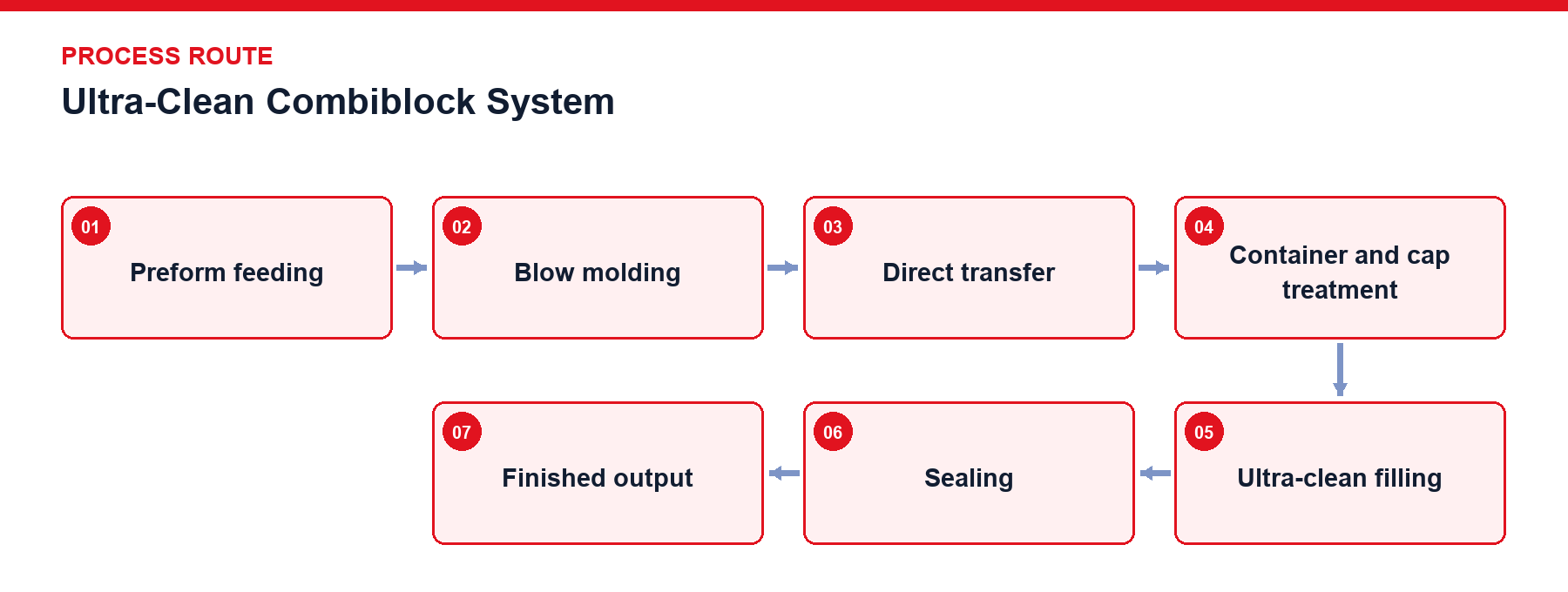
Preform Feeding: Automated preform orientation and infeed.
Blow Molding: Stretch blow molding in controlled machinery enclosures.
Direct Transfer: Shortened neck-transfer path into the clean filling zone.
Container and Cap Treatment: Rinsing, sanitizing, or specialized handling matched to product requirements.
Ultra-Clean Filling: Volumetric or level filling within an isolated clean enclosure.
Sealing: Rotary sealing under filtered protective airflow.
Finished Output: Container discharge to downstream cooling or packaging.
Ultra-clean combiblock systems are deployed where enhanced packaging and filling environment controls are required, but the project does not mandate full aseptic cold-chain infrastructure. Formed PET containers transfer directly into a controlled filling zone, bypassing long-distance air conveyors and external exposure. The configuration is defined by product thermal treatment, filling temperature, container and cap treatment, filtered airflow, enclosure barriers, and cleanable equipment design. Simply adding external machine guards or localized fan filter units cannot replace holistic process design. Continuous running intervals, changeover frequency, and maintenance access dictate system recovery protocols. Production, cleaning, and recovery modes are interlocked via door status, product temperature, packaging treatment, and air-handling sensors.
Scroll horizontally to see all table columns.
| Design Object | Technical Description |
|---|---|
| Hygienic Boundary | Enhanced control covers post-blow transfer, packaging treatment, filling, sealing, and exposed equipment surfaces. |
| Product Conditions | Thermal pasteurization or UHT intensity, filling temperature, and product characteristics define system treatment grade. |
| Packaging Treatment | Container and cap sanitization methods match packaging material properties and shelf-life targets. |
| Filtered Airflow | Air filtration, directional airflow, and differential pressure in critical zones participate in production interlocks. |
| Cleanable Design | Product circuits integrate into CIP systems, while open surfaces feature sloped drainage and cleanable structures. |
| Direct Connection | Synchronized speed across blow molding, filling, and capping with defined fault deceleration and shutdown sequences. |
Scroll horizontally to see all table columns.
| Component | Function |
|---|---|
| Blow and Direct Transfer Unit | Forms containers and transfers them without open air conveyors under synchronized motion. |
| Packaging Treatment Module | Treats container bodies and caps according to product hygiene specifications. |
| Controlled Filling Zone | Encloses filling carousels within barrier housing and filtered airflow. |
| CIP-Integrated Product Circuit | Connects product bowls, valves, and piping to automated cleaning loops. |
| Surface Treatment and Recovery | Executes pre- and post-production surface washing and environmental recovery. |
Preforms are blown and transferred directly into controlled filling zones, where containers and caps undergo project-defined hygienic treatment. Filling loops deliver thermally treated product, and sealed containers exit critical areas promptly. System control is maintained via clean zone pressure and airflow monitoring, packaging treatment interlocks, filling temperature permits, production/cleaning mode interlocks, and maintenance door recovery programs.
Product circuits, filler bowls, and feed pipes integrate fully into CIP cleaning loops, while observation windows, door seals, and drainage structures maintain barrier isolation. Clean air filters and differential pressure measurement points are maintained per project schedules, and packaging changeover procedures cover media residue removal and low-point drainage.
Enhanced container and cap treatment modules.
Diverse isolation ranges and filtered air configurations.
Automatic surface cleaning and environmental recovery programs.
Critical temperature, door position, and program event logging.
Ultra-clean combiblocks provide enhanced hygienic control and filling environment isolation tailored for extended shelf-life requirements, whereas aseptic combiblocks establish full commercial sterility for sensitive cold-filled beverages without preservatives.
Product circuits integrate into automated CIP loops, while open machinery surfaces feature cleanable structural profiles, sloped drainage, and barrier housings to prevent liquid accumulation.
Yes. Clean zone pressure differentials, airflow status, barrier door positions, and product temperatures participate directly in production interlocks.
Elevate product hygiene and extend distribution reach for sensitive beverages with our ultra-clean combiblock systems. Contact our technical team to review your product specifications and line design requirements.
Discuss your project