Application scope
- The application scope covers fixed-format film bundles, fixed-format corrugated cartons, and continuous production lines with minimal layer pattern changes.

Secondary Packaging and End of Line
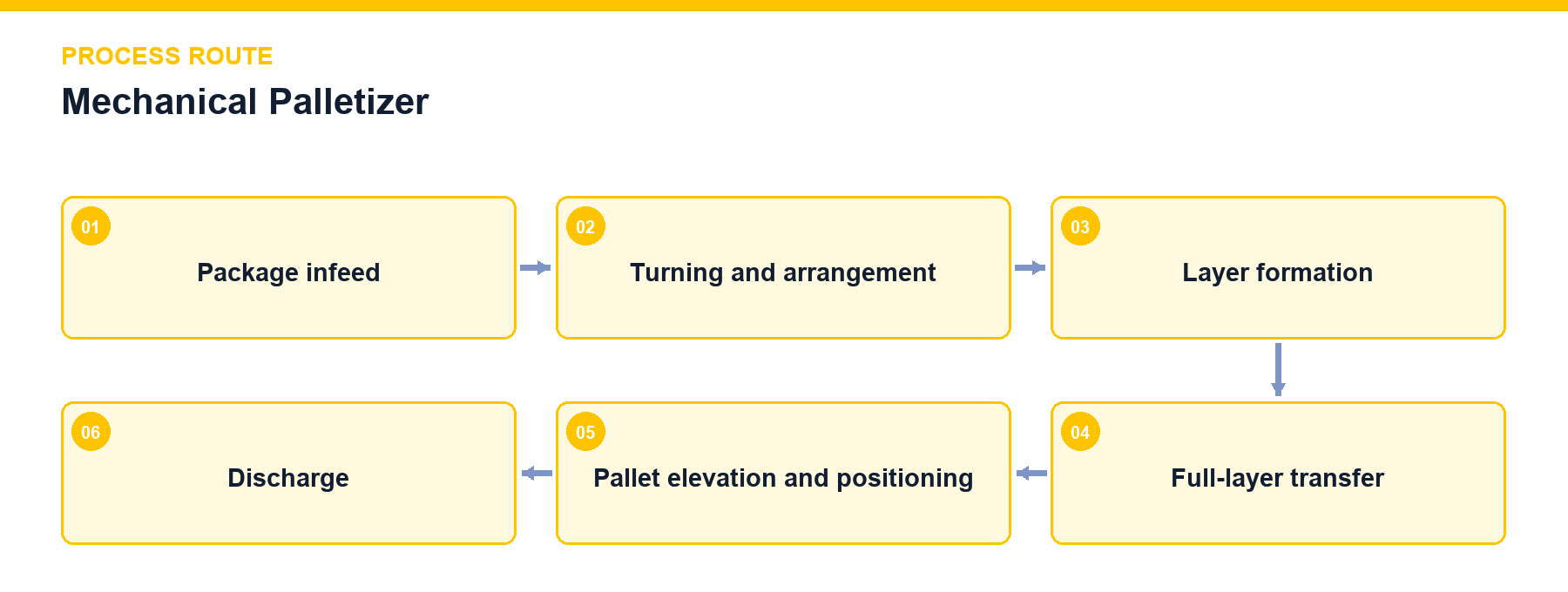
The mechanical palletizer utilizes gantry, column, layer-push, or lifting platform mechanisms to organize packaging units into fixed layer patterns and transfer them onto pallets for high-stability continuous production.
Project fit snapshot
Suitability depends on the product, container, output, hygienic route and connected equipment. Conditions outside the published scope require engineering review.
Technical content: fourth editionProject records shown below are project-specific references, not standard specifications.
The mechanical palletizer utilizes gantry, column, layer-push, or lifting platform mechanisms to organize packaging units into fixed layer patterns and transfer them onto pallets for high-stability continuous production.
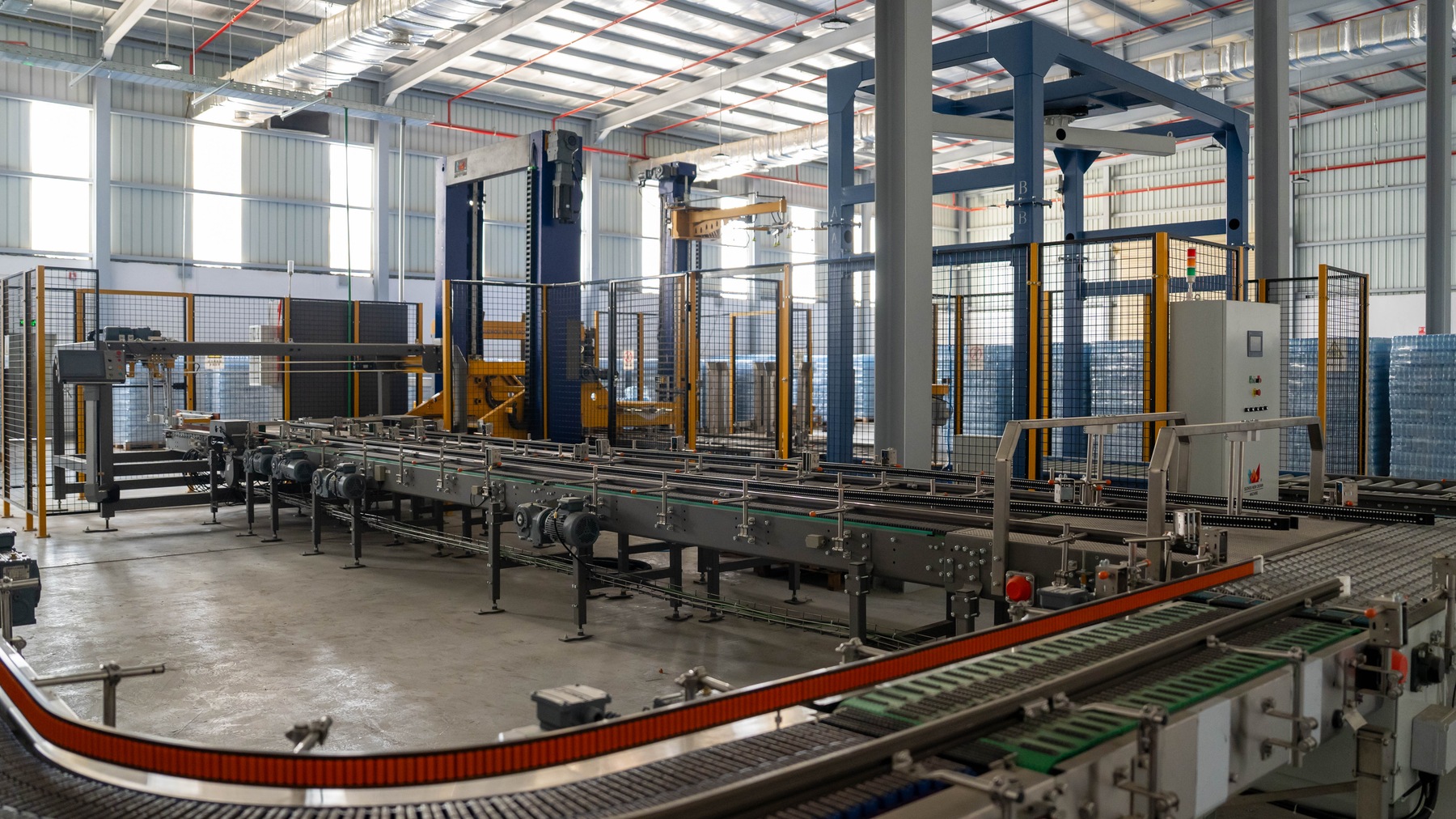
Project reference — mechanical palletizing and pallet handling area.
The mechanical palletizer utilizes division, turning, layer formation, layer pushing, and lifting mechanisms to stack packaging units onto pallets according to fixed layer patterns. Compared to robotic palletizers, mechanical palletizers feature fixed motion kinematics, making them well-suited for stable packaging formats and low-changeover production tasks. Incoming packages are arranged into layer configurations, and once layer formation and quantity verification are complete, layer transfer mechanisms move the complete layer onto pallets or elevator platforms. Pallet elevation, layer pushing, and stop gates operate in sequential interlocks to maintain package support during transfer.
Scroll horizontally to see all table columns.
| Design Object | Technical Description |
|---|---|
| Division and Turning | Converting packages into required orientations, rows, and columns. |
| Layer Formation Platform | Confirming per-layer quantities and edge alignment. |
| Layer Pushing/Transfer | Smoothly moving complete layers onto pallets or elevation platforms. |
| Pallet Elevation | Step-by-step height adjustment maintaining support as layers accumulate. |
| Safety Protection | Perimeter fencing, door locks, and maintenance modes covering layer-pushing, lifting, and pallet movement zones. |
Scroll horizontally to see all table columns.
| Component | Function |
|---|---|
| Package Infeed and Turning Unit | Adjusts packages to required layer orientations. |
| Layer Formation Platform | Organizes complete layers by rows and columns. |
| Layer Pushing or Transfer Mechanism | Moves completed layers onto pallets. |
| Pallet Elevation and Positioning Unit | Adjusts pallet height per layer. |
| Pallet Circulation Unit | Manages empty pallet supply and full pallet discharge. |
Operation and control encompass package counting and orientation verification, complete layer formation permission, layer pushing and elevation position interlocks, empty and full pallet detection, and safety door/mechanism movement interlocks.
Cleaning and maintenance require inspecting wear, lubrication, and fasteners on layer platforms, guides, chains, and lifting mechanisms, verifying package orientation, per-layer counts, transfer paths, and stack geometry following layer pattern changeovers, and conducting pre-palletizing inspections to remove damaged packages, deformed bundles, or broken pallets.
Scroll horizontally to see all table columns.
| Input Parameter | Description |
|---|---|
| Package Specs | Dimensions, weight, layer patterns, and pallet dimensions. |
| Speed & Stack | Target speed, stack height, and interlayer slip sheet requirements. |
| Changeover & Space | Allowable changeover scope, installation height, and maintenance space. |
Project reference only — not a standard specification.
Scroll horizontally to see all table columns.
| Project Description | Configuration / Parameter | Use Boundary |
|---|---|---|
| 10,000 BPH PET CSD Line | End-line sequence incorporating film wrapping, automatic palletizing, full pallet discharge, and online stretch wrapping | Project System Configuration |
Mechanical palletizers are ideal for high-speed, single-format production lines with fixed layer patterns, whereas robotic palletizers suit multi-format lines requiring frequent recipe changes.
Synchronized layer formation platforms, push plates, and elevator indexing maintain continuous support of packaging units throughout the transfer and stacking sequence.
Consult our packaging engineering team to evaluate whether a mechanical palletizer matches your line speed and format stability requirements.
Discuss your project