Application scope
- The application scope includes PET hot-filled fruit juices, tea beverages, and other hot-filled products utilizing post-capping bottle inversion treatment.

Secondary Packaging and End of Line
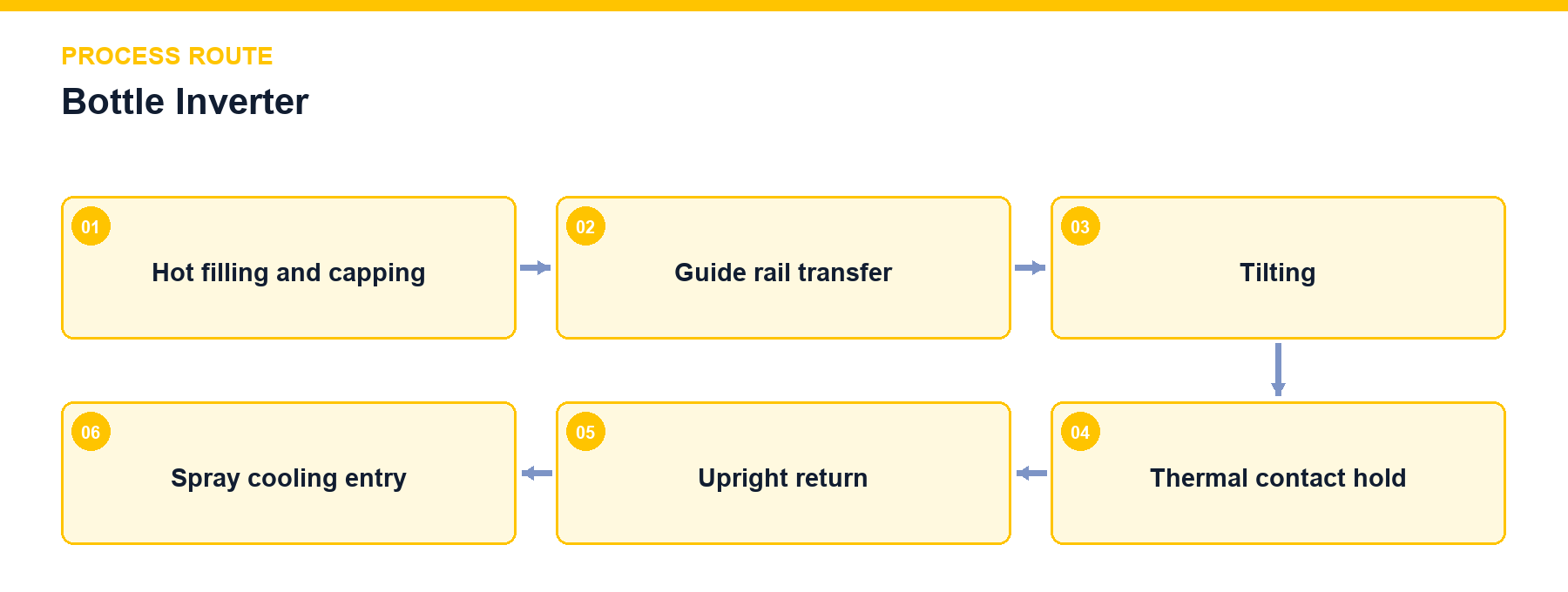
The bottle inverter is installed immediately following hot-filling and capping machines, using continuous guiding mechanisms to tilt sealed containers so hot beverage liquid contacts the interior neck finish and cap surface before returning containers to an upright position for cooling.
Project fit snapshot
Suitability depends on the product, container, output, hygienic route and connected equipment. Conditions outside the published scope require engineering review.
Technical content: fourth editionProject records shown below are project-specific references, not standard specifications.
The bottle inverter is installed immediately following hot-filling and capping machines, using continuous guiding mechanisms to tilt sealed containers so hot beverage liquid contacts the interior neck finish and cap surface before returning containers to an upright position for cooling.
The bottle inverter is positioned between hot-filling/capping and spray cooling. The system utilizes guide rails or tilting mechanisms to temporarily incline sealed containers, allowing hot liquid to contact container neck interiors and inner cap surfaces before returning containers to upright postures for downstream processing. Inversion duration is determined by transport speed and active guide path geometry. Adjustments to guide rails, tilt angles, and speeds are executed when container shapes, neck finishes, liquid levels, or thermal resistance change, followed by stability verification upon return to upright orientation.
Scroll horizontally to see all table columns.
| Design Object | Technical Description |
|---|---|
| Tilt Guiding | Continuous container attitude adjustment without mechanical pinching. |
| Contact Time | Governed by active inversion path length and operational line speed. |
| Container Constraints | Shoulder, base, liquid level, and center of gravity influencing inversion stability. |
| Upright Return | Stable container righting prior to discharge matching cooling tunnel infeed timing. |
Scroll horizontally to see all table columns.
| Component | Function |
|---|---|
| High-Temperature Transport Chain | Carries hot bottles at defined speeds. |
| Tilting Guide Mechanism | Transitions containers smoothly into inverted or inclined attitudes. |
| Holding Section | Provides contact duration for hot liquid against neck and cap interior surfaces. |
| Reset Guide Rails | Prevent sudden tumbling and ensure stable return to upright posture. |
| Format Adjustments | Adapt guide positions for bottle height, diameter, and shape. |
Operation and control encompass transport speed and contact time control, upstream and downstream speed interlocking, bottle jam and fallen bottle detection, format change position verification, and emergency stop and safety interlock circuits.
Cleaning and maintenance require regular cleaning, smoothness inspection, and wear checks on guide rails and bottle contact surfaces, preventing bottle jams in inversion zones to avoid prolonged high-temperature stagnation, and verifying inversion duration, liquid contact, and upright discharge stability after format changeovers.
Scroll horizontally to see all table columns.
| Input Parameter | Description |
|---|---|
| Container Geometry | Bottle shape, height, diameter, and filling liquid level. |
| Thermal Parameters | Post-capping product temperature and target contact duration. |
| Line Speed & Limits | Target bottle speed and container thermal deformation limits. |
Project reference only — not a standard specification.
Scroll horizontally to see all table columns.
| Project Description | Configuration / Parameter | Use Boundary |
|---|---|---|
| 5,000 BPH, 500 mL PET Juice Hot-Fill Line | Installed between capping and spray cooling; inversion angle approx. 96–110°, thermal hold duration approx. 30–40 s | Project Equipment Log |
No. The inverter's primary function is thermal sanitization of the cap and neck finish via hot liquid contact, while bulk cooling is performed downstream in the spray cooling tunnel.
Precision guide rails cradle the bottle geometry by its neck and base flanges, ensuring smooth continuous rotation and stable upright return.
Contact our technical team to determine the precise dwell time and mechanical configuration required for your hot-fill bottle inversion line.
Discuss your project