Application scope
- The application scope encompasses PET single bottles, film-wrapped bundles, corrugated cartons, and other beverage finished packaging formats confirmed by specific dimensions and weight parameters.

Secondary Packaging and End of Line
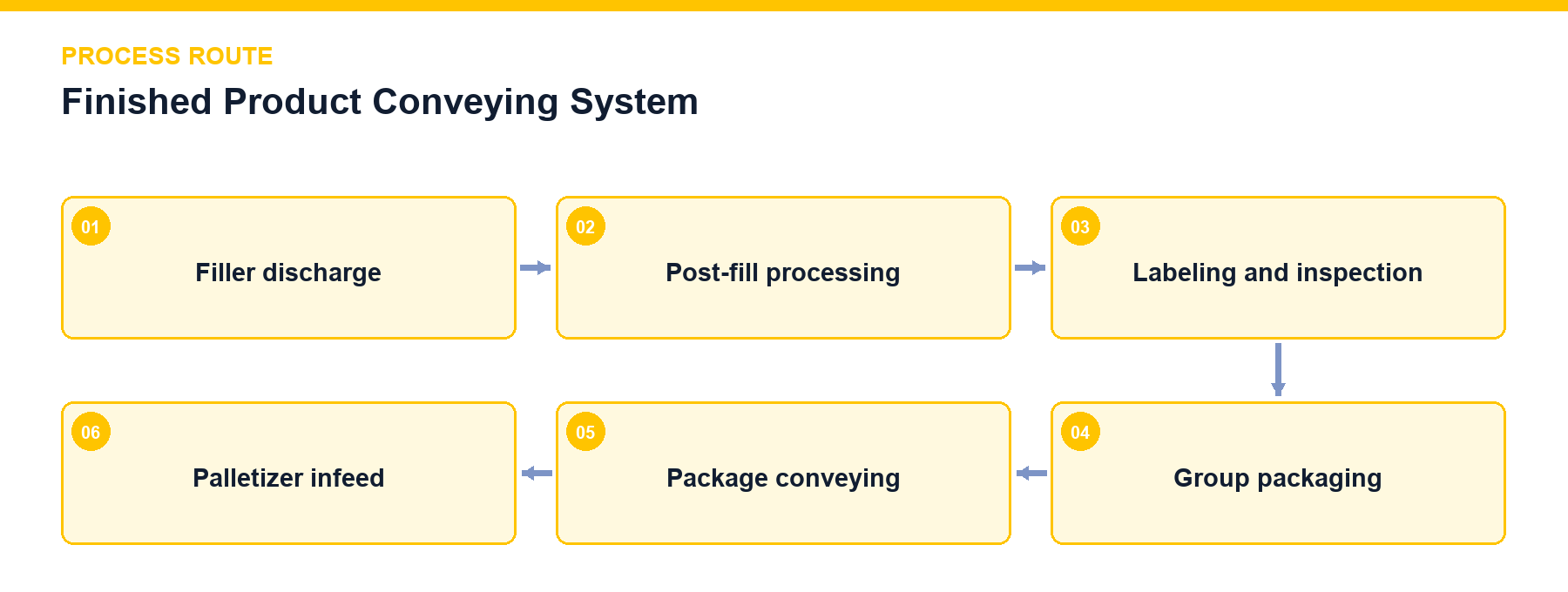
The finished product conveying system provides continuous, synchronized transfer of filled single bottles, grouped multipacks, and corrugated cartons across post-filling inspection, labeling, packaging, and palletizing stations.
Project fit snapshot
Suitability depends on the product, container, output, hygienic route and connected equipment. Conditions outside the published scope require engineering review.
Technical content: fourth editionProject records shown below are project-specific references, not standard specifications.
The finished product conveying system provides continuous, synchronized transfer of filled single bottles, grouped multipacks, and corrugated cartons across post-filling inspection, labeling, packaging, and palletizing stations. As containers transition from individual bottles to secondary packages and palletized loads, transport mechanisms adapt from single-bottle top chains to specialized package conveyors. The system maintains container stability, manages dynamic line accumulation, and coordinates speed cascading between upstream filling equipment and downstream palletizers to ensure smooth operational continuity across the packaging hall.
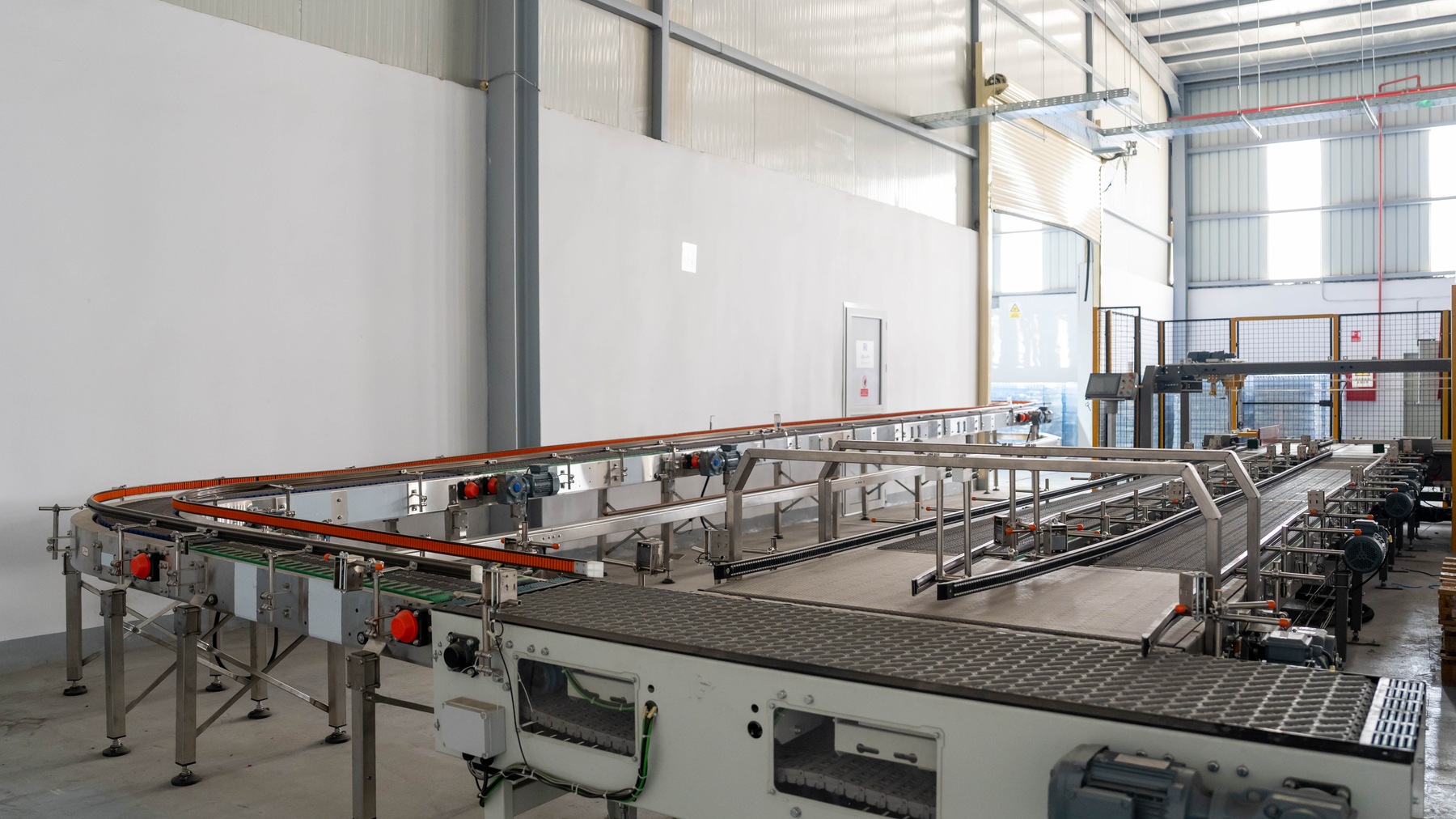
Project reference — end-of-line conveying interface.
The conveying architecture handles three distinct container types with varying support requirements, speeds, allowable accumulation, and turning radii, necessitating dedicated single-bottle slat chains, package conveyors, and pallet conveyors rather than a universal conveyor layout. Typical post-line routes include bottle temperature adjustment, air-drying, labeling, coding, film wrapping, palletizing, and stretch wrapping. Each equipment infeed establishes in-bound status, entry permission, full-load, and fault signals, allowing the conveying system to adjust speeds hierarchically based on buffer occupancy. Bottle air-drying and laser coding serve as inline auxiliary stations integrated into bottle transport and labeling trigger logic.
Scroll horizontally to see all table columns.
| Design Object | Technical Description |
|---|---|
| Single-Bottle Transport | Slat chains, guide rails, and lubrication methods selected based on bottle base stability, temperature, and line speed. |
| Package Conveyor | Belts, rollers, or slat chains selected according to film bundle or carton dimensions, weight, and bottom structure. |
| Equipment Transfer | Infeed spacing, discharge speed, and height benchmarks matched with labeling, wrapping, and palletizing equipment. |
| Bottle Air-Drying | Vortex or air-knife units removing surface moisture after warming, cooling, or rinsing to optimize labeling and coding conditions. |
| Coding Trigger | Container or package position sensors triggering laser coders, with coding equipment status participating in transport release permissions. |
| Accumulation and Recovery | Zoned sensing and speed cascading absorb short stoppages, releasing from downstream upward upon recovery. |
Scroll horizontally to see all table columns.
| Component | Function |
|---|---|
| Flat-Top Chains or Modular Belts | Provide continuous support from container or package bases. |
| Guard Rails and Guides | Maintain container orientation and adapt to format changeovers. |
| Division, Convergence, and Turning Units | Organize layout and timing between multiple machines. |
| Zoned Drives | Ensure smooth transfer and short-term accumulation according to process speeds. |
| Detection and Line Control Units | Identify congestion, missing material, and fallen bottles while coordinating upstream and downstream speeds. |
Operation and control encompass zoned speed control, congestion and missing-material detection, upstream and downstream start-stop cascading, container or package anomaly alarms, and maintenance emergency stop and safety circuits.
Cleaning and maintenance require ensuring proper drainage, cleaning accessibility, and maintenance access for chains, guides, and equipment bases, regularly cleaning air-dryer unit inlet filters, air knives, and spray nozzles, and scheduling inspections for transport wear, guide rail alignment, and lubrication changes affecting bottle flow stability.
Scroll horizontally to see all table columns.
| Input Parameter | Description |
|---|---|
| Packaging Object | Dimensions and weight of single bottles, bundles, or cartons. |
| Operational Speed | Target line speed and maximum throughput. |
| Geometry and Center of Gravity | Bottom surface, center of gravity, turning radii, and elevation gradients. |
| Accumulation and Interface | Required accumulation time, equipment interface height, and format changeover scope. |
Project reference only — not a standard specification.
Scroll horizontally to see all table columns.
| Project Description | Configuration / Parameter | Use Boundary |
|---|---|---|
| 10,000 BPH, 300 mL PET Water Line | Air-drying equipment CG-1, 10,000 BPH, 7.5 kW | Project Configuration |
| 10,000 BPH, 330 mL PET CSD Line | Air-drying equipment CG-1, 10,000 BPH, 5.5 kW | Project Configuration |
| 5,000 BPH, 500 mL PET Hot-Fill Line | Post-line sequence including spray cooling followed by air drying, sleeve labeling, coding, and film wrapping | Project Operational Flow |
Single bottles, film bundles, and full pallets have different base support requirements, weights, and stability profiles, requiring dedicated slat chains, package belts, and roller conveyors to maintain smooth transfer and prevent tipping.
Zoned photoelectric sensors detect line congestion or downstream slowing, initiating hierarchical speed reductions and controlled accumulation to absorb short stoppages without shutting down upstream filling equipment.
Contact our engineering team to evaluate your plant layout, line speed requirements, and container specifications for a customized conveying system proposal.
Discuss your project