Application scope
- Carbonated soft drink production
- Carbonated sparkling water production
- Carbonated mineral water production

Pretreatment and Process Systems
The Carbonated Beverage Mixing and Carbonation System continuously proportions treated water and sugar syrups or base concentrates, removes dissolved gases via vacuum degassing, cools the mixture, and injects precise volumes of carbon dioxide (CO2) to establish product conditions suitable for isobaric filling.
Project fit snapshot
Suitability depends on the product, container, output, hygienic route and connected equipment. Conditions outside the published scope require engineering review.
Technical content: fourth editionProject records shown below are project-specific references, not standard specifications.
The Carbonated Beverage Mixing and Carbonation System continuously proportions treated water and sugar syrups or base concentrates, removes dissolved gases via vacuum degassing, cools the mixture, and injects precise volumes of carbon dioxide (CO2) to establish product conditions suitable for isobaric filling. The system maintains rigorous control across flow ratios, temperatures, pressures, and buffer liquid levels.
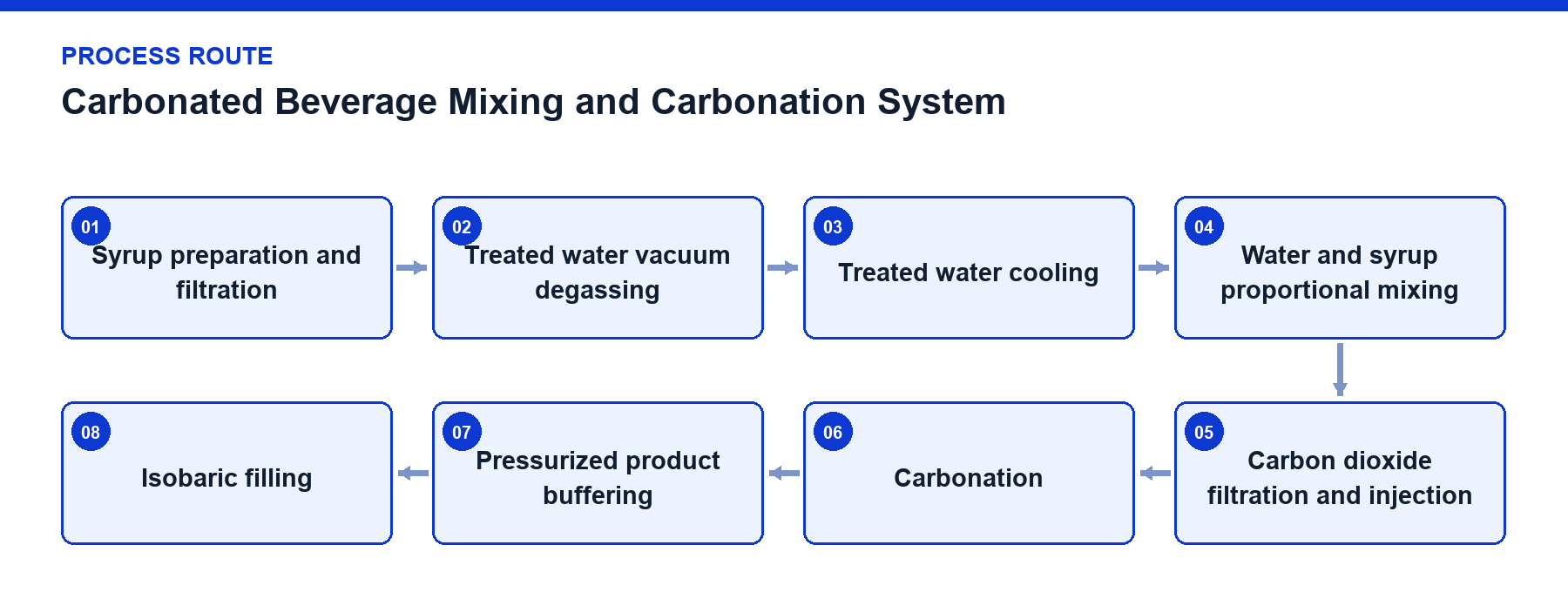
Carbonated beverage preparation route comprises:
01 Syrup preparation and filtration -> 02 Treated water vacuum degassing -> 03 Treated water cooling -> 04 Water and syrup proportional mixing -> 05 Carbon dioxide filtration and injection -> 06 Carbonation -> 07 Pressurized product buffering -> 08 Isobaric filling.
Carbonated beverage preparation is executed continuously through degassing, proportional mixing, cooling, carbonation, and pressurized buffering. Treated water first expands its gas-liquid contact area under vacuum to discharge native dissolved gases, subsequently mixing online with syrup according to established flow relationships, passing through plate heat exchangers for cooling, and receiving carbon dioxide injection.
Proportion control is not an isolated valve operation. Water pumps, syrup pumps, flow meters, control valves, and controllers constitute a closed-loop system; variations in water flow trigger proportional adjustments in syrup delivery to maintain target formulation ratios. When temperature, flow rate, or brix parameters deviate from permitted ranges, the system initiates alarms, recirculates product, or restricts supply to the filling machine.
The carbonation stage establishes stable filling supply conditions through regulated CO2 gas supply, gas-liquid mixing structures, and pressurized finished product surge tanks. Online brix monitoring, CO2 analysis, and secondary deoxygenation are available as project options, but their measurement ranges, accuracies, and acceptance protocols must be defined within technical agreements.
Vacuum Degassing: Water enters degassing vessels via spray or atomization structures, while liquid-ring vacuum pumps maintain negative pressure to extract released gases.
Water and Syrup Mixing: Flow meters and modulating control valves adjust syrup addition rates based on treated water flow and target formulation ratios.
Low-Temperature Heat Exchange: Plate heat exchangers connected to chilled water or glycol systems cool the mixture to temperature zones optimized for carbonation and isobaric filling.
Carbon Dioxide Treatment: Filtered and pressure-regulated carbon dioxide enters mixing devices or injection carbonation sections at controlled flow rates.
Pressurized Buffering: Finished product tanks absorb short-term hydraulic fluctuations from upstream and downstream sections while maintaining delivery pressures required by filling machines.
Liquid Level and Pressure: Liquid levels within degassing tanks, syrup tanks, water tanks, and finished product tanks participate in pump, valve, and supply permit interlocks.
Product Changeover: Changeover sequences manage residual product, ratio transitions, recirculation pathways, and CIP cleaning boundaries.
Cold Source Sizing: Water chillers, cooling towers, circulation pumps, and storage tanks are selected according to maximum thermal load and ambient environmental conditions.
Scroll horizontally to see all table columns.
| Component | Function |
|---|---|
| Syrup Tank and Treated Water Tank | Store dual liquid streams designated for proportional mixing |
| Vacuum Degassing Tank and Liquid-Ring Vacuum Pump | Reduce native dissolved gases within treated water |
| Sanitary Pumps, Flow Meters, and Ratio Valves | Establish continuous supply flow and regulate water-to-syrup mixing ratios |
| Plate Cooler | Lowers treated water or mixture temperatures to levels optimized for carbonation |
| Carbon Dioxide Filtration and Regulation Assembly | Filters, regulates, and injects carbon dioxide into product streams |
| Mixing Carbonation Tank and Pressurized Buffer Tank | Provide gas-liquid contact surface area and stable isobaric filling supply pressure |
Scroll horizontally to see all table columns.
| Step | Operation | Control and Verification |
|---|---|---|
| 1 | Establish Water, Syrup, and Cold Sources | Verify tank levels, pump statuses, chilled water availability, and CO2 supply conditions. |
| 2 | Treated Water Degassing | Maintain vacuum degree and degassing tank liquid levels. |
| 3 | Proportional Mixing | Utilize water flow as primary reference; adjust syrup flow in closed-loop per formulation. |
| 4 | Product Cooling | Restrict entry into carbonation and filling stages when outlet temperatures deviate from targets. |
| 5 | Carbon Dioxide Injection and Carbonation | Coordinate gas supply pressure, gas flow rate, and product line pressure. |
| 6 | Pressurized Buffering and Supply | Interlock isobaric filling machine operation via finished product tank level and pressure. |
Treated water releases dissolved native gases under vacuum conditions and undergoes temperature reduction via plate heat exchange. Water and syrup are conveyed by sanitary pumps, where flow measurement instrumentation and proportional valves combine the two liquid streams according to predefined ratios. Filtered carbon dioxide is introduced into the liquid mixture, which maintains controlled pressure within carbonation and buffer containers before continuous delivery to isobaric filling machines. When temperatures rise, mixing ratios shift, or supply pressure fluctuates, the system prevents abnormal states from propagating directly to the filling machinery.
Closed-loop control governing water and syrup flow mixing ratios.
Interlocks between vacuum degree and degassing water supply systems.
Temperature control governing cooling section discharge parameters.
Pressure control regulating carbonation and buffer vessel pressures.
Tank high/low level interlocks coordinating with isobaric filling supply operations.
Syrup tanks, water tanks, degassing vessels, heat exchangers, carbonation assemblies, and finished product tanks require clearly defined CIP supply and return routing.
Liquid-ring vacuum pump seal water supply, plate heat exchanger pressure drops, and CO2 filter statuses require routine inspection.
Product changeover procedures require verification of empty and rinsed states across syrup branches, mixing lines, and pressurized buffer tanks before and after transitions.
Online analytical instruments function as measurement systems, requiring defined procedures for sampling, calibration, and production disposition during instrument faults.
Project reference only — not a standard specification.
Scroll horizontally to see all table columns.
| Project Configuration | Parameter / Equipment Item | Configured Value / Description | Usage Boundary |
|---|---|---|---|
| 10,000 BPH, 330 mL PET CSD Line | Carbonated Beverage Preparation Capacity | 4,000 LPH | Project configuration value |
| 10,000 BPH, 330 mL PET CSD Line | Mixing Equipment | QHS-5000B project configuration, five-tank layout, ratio range 1:7 to 1:13 | Project technical configuration |
| 10,000 BPH, 330 mL PET CSD Line | Degassing and Supply Package | Horizontal dual-chamber degassing tank, liquid-ring vacuum pump, dual-mechanical-seal sanitary pumps, syrup and water tanks | Project equipment schedule |
| 10,000 BPH, 330 mL PET CSD Line | Cold Source Package | 145 kW water chiller, cooling tower, circulation pumps, 3,000 L water tank | Verified per local environment and load |
| 48,000 BPH, 330 mL PET CSD Line | Continuous Mixing Capacity | 5 m³/h capacity; ratio range 1:7 to 1:13 | Project equipment configuration |
| 48,000 BPH, 330 mL PET CSD Line | Optional Analytical Package | Online CO2, online brix, combined analysis, and secondary deoxygenation | Project optional items |
| 10,000 BPH, 330 mL PET CSD Line | Main Structural Components | Dual-chamber degassing tank, syrup tank, water tank, proportional valve block, dual-channel heat exchanger, carbonation buffering | Project equipment schedule |
| 10,000 BPH, 330 mL PET CSD Line | Vacuum System | Liquid-ring vacuum pump and atomization degassing structure | Project equipment configuration |
| 48,000 BPH, 330 mL PET CSD Line | Supply Conditions | Continuous online mixing, cooling, carbonation, and pressurized surge feeding | Project equipment configuration |
The system utilizes closed-loop ratio control where syrup dosing pumps and proportional valves dynamically track water flow variations in real-time to maintain exact formulation ratios.
Online analytical instruments such as CO2 and brix sensors alongside secondary deoxygenation systems are configured as optional project integrations based on specific quality control and automation specifications.
Contact our beverage engineering specialists to configure a mixing and carbonation system tailored to your production targets.
Discuss your project