Application scope
- Single-use large-format PET drinking-water containers.
- Production lines seeking to reduce empty large-bottle storage and long-distance handling.

Integrated Combiblock Systems
The large-container PET combiblock system is engineered for single-use large-format PET containers, completing large preform heating, container forming, drinking water filling and sealing within a continuous equipment group.
Project fit snapshot
Suitability depends on the product, container, output, hygienic route and connected equipment. Conditions outside the published scope require engineering review.
Technical content: fourth editionProject records shown below are project-specific references, not standard specifications.
The large-container PET combiblock system is engineered for single-use large-format PET containers, completing large preform heating, container forming, drinking water filling and sealing within a continuous equipment group. Mold space, heating load, blowing-air demand, container transfer and filling rhythm are defined for the confirmed container geometry. Direct connection reduces the storage, handling and long-distance transfer required for large empty containers.
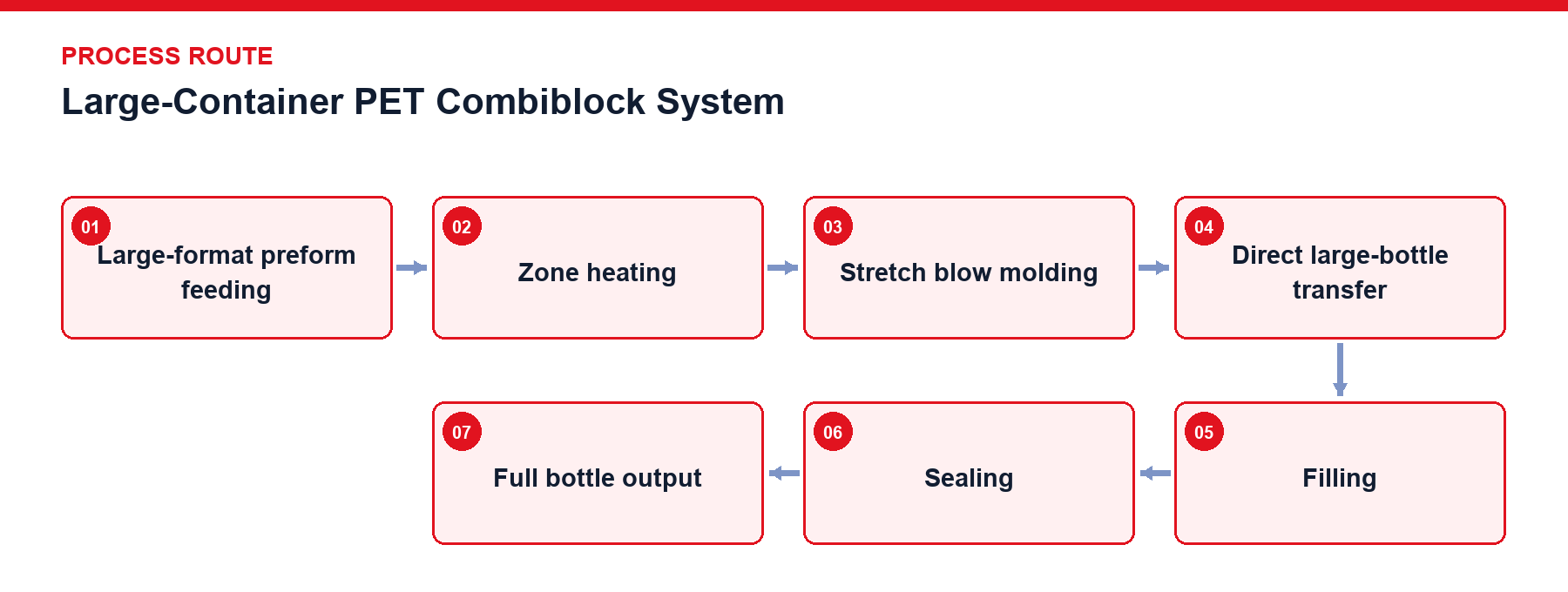
Large-Format Preform Feeding: Orientation and feeding of large-format preforms.
Zone Heating: Distributed thermal heating across heavy preform walls.
Stretch Blow Molding: High-clamp-force axial stretching and high-pressure blowing.
Direct Large-Bottle Transfer: Secure neck-clamped transfer of large containers.
Filling: Low-viscosity still beverage filling via controlled liquid delivery.
Sealing: High-torque application of large-diameter screw caps.
Full Bottle Output: Discharge of filled large containers to downstream handling.
Integrating large PET container forming, still water filling, and sealing into a continuous process requires robust mechanical coordination. Large preforms possess substantial thermal capacity, extended heating times, and longer stretch strokes, meaning blow molding cycle times govern overall line output. Filling and sealing units must account for increased container mass, liquid sloshing inertia, and precise neck positioning. Equipment selection cannot rely on volume alone; preform weight, neck finish, maximum diameter and height, handle integration requirements, filling level precision, and bottom load-bearing capacity must be jointly evaluated.
Scroll horizontally to see all table columns.
| Design Object | Technical Description |
|---|---|
| Large Preform Heating | Heating conditions are selected from preform length, thermal load and target container geometry. |
| Blowing and Cooling | Blowing-air demand and mold cooling are matched to the longer forming and cooling cycles of large containers. |
| Container Support | Transfer and filling arrangements control bottle-body swing, bottom support and transfer height. |
| Filling Rhythm | Blowing cycle, filling time and product supply are matched to define line output. |
| Cap Supply | Cap handling and capping are selected from the specified cap geometry and orientation. |
| Changeover and Maintenance | Mold, guide, support and capping components are defined from the selected container and cap format. |
Scroll horizontally to see all table columns.
| Component | Function |
|---|---|
| Large-Format Blow Unit | Provides the heating, mold space and blowing capacity required by the selected large-format container. |
| Neck Grip and Support Transfer | Maintains stable container transfer under increased weight and dimensional inertia. |
| Filling Unit | Delivers the specified product and performs the project-defined filling operation. |
| Sealing Unit | Accommodates large-diameter neck finishes and caps with torque-controlled sealing. |
| Changeover Components | Provides the project-defined mold, guide, support and capping components for selected formats. |
Large container preforms are fed and oriented, entering zone-controlled heating tunnels and heavy-duty blow molding units. Formed containers transfer directly via neck-clamped support mechanisms to still water filling units, followed immediately by cap sealing and full bottle discharge. Operational sequence and controls are verified through preform orientation checks, heating and blow parameter interlocks, container integrity verification, water fill permits, missing cap detection, and downstream jam deceleration sequences.
Product bowls, liquid distribution manifolds, and filling valves integrate into automated CIP cleaning loops. Contact guides and container support surfaces for large bottles require routine sanitization to prevent abrasion marks. Mold cooling circuits, compressed air filtration, and pneumatic regulators require proactive maintenance, while cap feeding tracks and sealing heads follow strict hygiene and wear inspection schedules.
Project-specific optional configurations to be confirmed from the selected container, cap and downstream packaging route.
Project Reference Only — Not a Standard Specification
The figures below apply exclusively to the specified project configuration to illustrate engineering matching against specific products and capacities; they do not represent standard performance metrics for other projects.
Scroll horizontally to see all table columns.
| Project Item | Configuration / Operating Condition | Description |
|---|---|---|
| Large-Container System | Container range and line capacity are project-specific | Final configuration is verified against preform specifications, container geometry and auxiliary equipment configuration. |
The system is designed for single-use large-format PET containers. The applicable volume range must be confirmed from the preform, neck finish, maximum diameter, height, handle structure and downstream handling requirements.
The transfer arrangement is defined to control bottle-body swing, bottom support and transfer height after large containers are formed and before they are filled and capped.
The required mold, guide, support and capping components must be defined from the preform, bottle dimensions, neck finish, cap and packaging format.
Streamline your large-format PET container production lines with our specialized large-container combiblock systems. Contact our engineering team to review your container specifications and facility layout requirements.
Discuss your project