Application scope
- Juice beverage preparation
- Tea beverage preparation
- Functional beverage preparation

Pretreatment and Process Systems
The Beverage Processing and Blending System converts process water, liquid sugars, concentrates, and auxiliary ingredients into homogeneous finished product materials ready for filling.
Project fit snapshot
Suitability depends on the product, container, output, hygienic route and connected equipment. Conditions outside the published scope require engineering review.
Technical content: fourth editionProject records shown below are project-specific references, not standard specifications.
The Beverage Processing and Blending System converts process water, liquid sugars, concentrates, and auxiliary ingredients into homogeneous finished product materials ready for filling. Integrating thermal preparation, dissolution or emulsification, batching, filtration, homogenization, continuous thermal treatment, cooling, and buffer supply units, the system architecture accommodates diverse juice, tea, functional, and protein-based liquid beverage formulations.
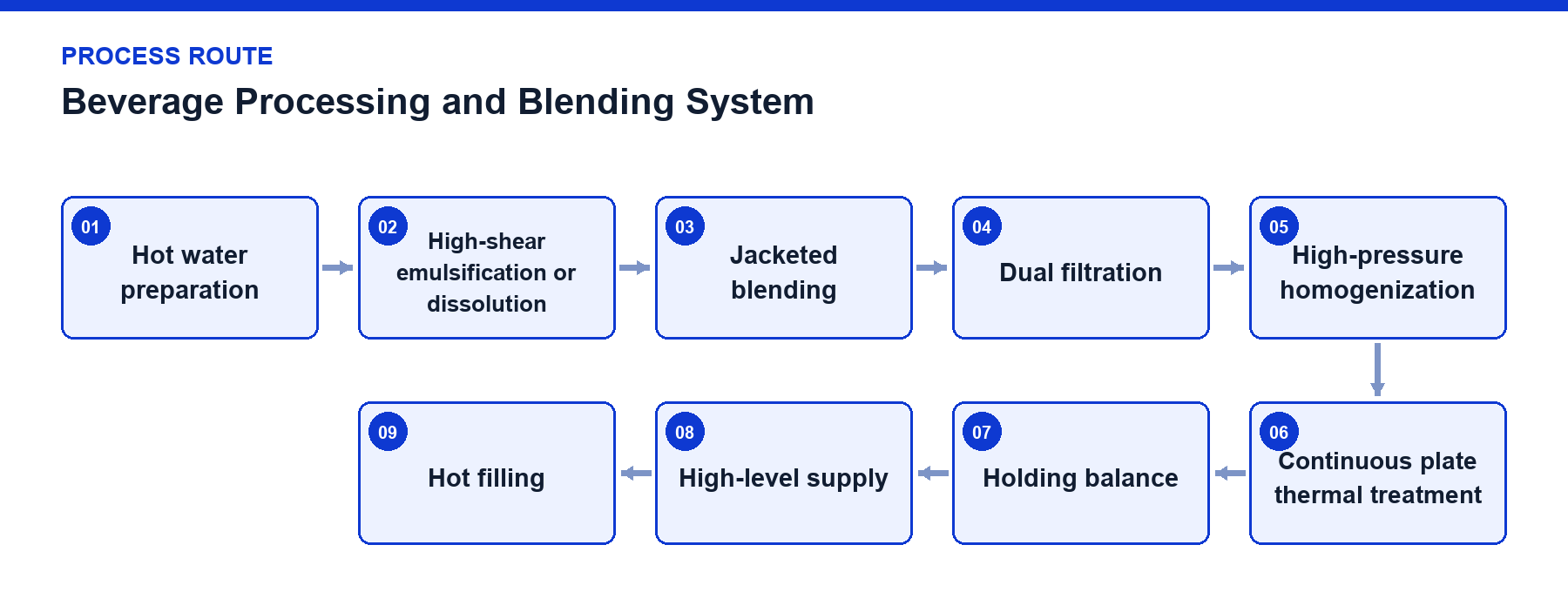
Hot-fill material processing route comprises:
01 Hot water preparation -> 02 High-shear emulsification or dissolution -> 03 Jacketed blending -> 04 Dual filtration -> 05 High-pressure homogenization -> 06 Continuous plate thermal treatment -> 07 Holding balance -> 08 High-level supply -> 09 Hot filling.
The core of beverage processing engineering lies in organizing raw material dissolution, dispersion, filtration, homogenization, thermal treatment, and filling supply into repeatable material pathways. Material viscosity, particle profiles, thermal sensitivity, and foaming characteristics govern vessel geometry, agitation mechanisms, filtration precision, pump types, and heat exchange routing.
Hot-fill juice processing illustrates a comprehensive production chain: process water is heated within a hot water tank and plate heat exchange loop, powders or colloids are dispersed within a high-shear emulsification vessel, main formulations are blended in jacketed mixing tanks, and materials subsequently pass through dual-stage filtration, high-pressure homogenization, continuous plate thermal treatment, holding balance, and high-level supply headers.
The continuous thermal treatment stage utilizes discharge temperature as a primary process indicator. When product temperatures fall outside specified thresholds, valve assemblies maintain recirculation or isolation modes; materials are released to balance tanks or filling supply loops only when temperature, flow rate, and downstream supply prerequisites are simultaneously satisfied.
Hot Water Preparation: Hot water tanks, circulation pumps, plate heat exchangers, and steam control valves jointly supply stable hot water for batching operations.
High-Shear Dispersion: Utilized for rapid wetting and dispersion of powders, colloids, or difficult auxiliary ingredients, with rotational speed and duration established via formulation trials.
Jacketed Blending: Mixing vessels perform main formulation blending alongside heating or cooling, managing feeding and transfer operations through liquid level supervision.
Dual Filtration: Two filter housings connected via switching valves maintain continuous material passage during maintenance of either filter side.
High-Pressure Homogenization: Configured according to specific emulsion systems and suspension stability requirements rather than serving as a universal standard across all products.
Plate Thermal Treatment: Heat exchange plates, material pumps, hot water pumps, steam control valves, recirculation valves, and temperature sensors constitute the continuous thermal control loop.
Balance and High-Level Supply: Absorb short-term flow rate discrepancies between thermal treatment and filling operations while preventing unconditioned material from entering filling machinery.
Hygienic Piping: Tank cleaning spray balls, sanitary pumps, valve groupings, sampling points, and drain connections are integrated within a unified CIP boundary.
Scroll horizontally to see all table columns.
| Component | Function |
|---|---|
| Hot Water Preparation System | Centrally heats process water and supplies batching stations |
| High-Shear Emulsification Tank | Rapidly mixes powders, colloids, or difficult-to-disperse auxiliary ingredients |
| Jacketed Blending Tank | Executes main formulation mixing, temperature maintenance, and batch buffering |
| Dual Filter | Alternates between filter housings to sustain material flow during maintenance |
| High-Pressure Homogenizer | Refines dispersion states for suspended particles or emulsion systems |
| Plate Continuous Thermal Treatment Equipment | Manages preheating, heating, holding, and discharge temperature control |
| Balance Tank and High-Level Tank | Absorb short-term flow fluctuations between pretreatment and filling operations |
Scroll horizontally to see all table columns.
| Step | Operation | Control and Verification |
|---|---|---|
| 1 | Establish Hot Water and Utilities | Verify steam supply, cooling water, pumps, and tank levels. |
| 2 | Raw Material Dissolution or Emulsification | Manage liquid levels, agitation speed, and temperature according to charging sequence. |
| 3 | Main Formulation Blending | Complete batch mixing and confirm material transfer readiness. |
| 4 | Filtration and Homogenization | Monitor filtration status, pump protection interlocks, and homogenizer operating permits. |
| 5 | Continuous Thermal Treatment | Divert product flow back via recirculation when discharge temperature is unqualified; prevent filler supply. |
| 6 | Balance and High-Level Supply | Coordinate upstream and downstream pacing utilizing tank levels and filling machine demands. |
The hot water system establishes required batching temperatures. Raw materials are dissolved and mixed within emulsification or blending tanks, pass through dual filters to remove oversized particulate matter, and proceed to homogenization and continuous thermal treatment based on formulation requirements. Plate heat treatment sections modulate steam thermal input via outlet temperature feedback. When temperatures remain below set thresholds, materials return through recirculation pathways rather than entering filling supply headers. Qualified product enters holding balance or high-level supply systems for continuous delivery to filling machines.
Tank liquid levels govern raw material charging, transfer operations, and downstream supply permits.
Temperature controllers regulate steam valves or cooling media flow rates while recording continuous thermal treatment temperatures.
Equipment operating statuses, valve positions, and recirculation states participate in production and cleaning mode transitions.
Tanks, sanitary pumps, filters, heat exchangers, and supply piping require clearly defined joint or segregated CIP cleaning circuits.
Dual filter switching requires prior verification of valve positioning and isolation of the side undergoing maintenance, with filter bag or cloth specifications confirmed per material and project.
Plate heat exchange pressure drops, temperature approach values, and sealing conditions serve as primary inspection and maintenance parameters.
Shutdown and product changeovers require management of high-level tanks, recirculation lines, and low-point residuals to prevent undefined material intermixing.
Project reference only — not a standard specification.
Scroll horizontally to see all table columns.
| Project Configuration | Parameter / Equipment Item | Configured Value / Description | Usage Boundary |
|---|---|---|---|
| 5,000 BPH, 500 mL PET Hot-Fill Juice Line | Material Processing Capacity | 3,000 LPH | Project configuration value |
| 5,000 BPH, 500 mL PET Hot-Fill Juice Line | Processing Chain | Hot water preparation, emulsification, blending, dual filtration, homogenization, plate thermal treatment, balance and high-level supply buffering | Project configuration |
| 5,000 BPH, 500 mL PET Hot-Fill Juice Line | Filtration System | SUS316 dual bag filter equipped with 5 μm filter bags | Project selection value |
| 48,000 BPH, 330 mL PET CSD Line | Blending Tanks | Six units of 5,000 L blending tanks featuring top-offset agitation | Project equipment configuration |
| 5,000 BPH, 500 mL PET Hot-Fill Juice Line | Hot Water System | 2,000 L jacketed hot water tank, 8 m² plate heat exchanger | Project equipment schedule |
| 5,000 BPH, 500 mL PET Hot-Fill Juice Line | High-Shear Emulsification | 1,000 L vessel, 5.5 kW power, recorded rotation speed 2,900 rpm | Project equipment record |
| 5,000 BPH, 500 mL PET Hot-Fill Juice Line | Main Blending Tank | 2,000 L jacketed vessel with 1.5 kW low-speed agitation | Project configuration |
| 5,000 BPH, 500 mL PET Hot-Fill Juice Line | Continuous Thermal Treatment | 3 t/h capacity; recorded 120°C, 4–10 seconds holding time, discharge approximately 85°C | For expert verification only |
| 5,000 BPH, 500 mL PET Hot-Fill Juice Line | Buffering and Supply | 2,000 L insulated balance tank, 500 L high-level tank, 3 kW sanitary pump | Project equipment schedule |
| 48,000 BPH, 330 mL PET CSD Line | Syrup Preparation | One 1,000 L and two 3,000 L high-speed sugar dissolution tanks | Project equipment schedule |
| 48,000 BPH, 330 mL PET CSD Line | Hot Water System | 5,000 LPH hot water system, 4 t water tank, and 12 m² plate heat exchanger | Project equipment schedule |
No. Homogenization and high-shear mixing are configured strictly based on specific formulation requirements, such as emulsion stability or powder dispersion characteristics, rather than acting as universal standards.
The system incorporates automated diversion valves controlled by real-time outlet temperature feedback. When product temperature deviates below required parameters, material is automatically routed back through recirculation pathways rather than entering filling supply headers.
Contact our process engineering specialists to discuss your formulation requirements and establish a beverage processing and blending system proposal.
Discuss your project