Application scope
- The application scope covers low-temperature filled PET carbonated soft drinks and packaging routes requiring reduced container surface condensation.

Secondary Packaging and End of Line
The spray bottle warmer is a thermal conditioning system designed for low-temperature carbonated soft drink filling lines, utilizing multi-zone circulating water sprays to gradually elevate sealed container temperatures closer to ambient conditions.
Project fit snapshot
Suitability depends on the product, container, output, hygienic route and connected equipment. Conditions outside the published scope require engineering review.
Technical content: fourth editionProject records shown below are project-specific references, not standard specifications.
The spray bottle warmer is a thermal conditioning system designed for low-temperature carbonated soft drink filling lines, utilizing multi-zone circulating water sprays to gradually elevate sealed container temperatures closer to ambient conditions. By mitigating severe container surface condensation, the system optimizes subsequent air-drying, labeling, and packaging operations while preserving internal carbonation pressure and container integrity.
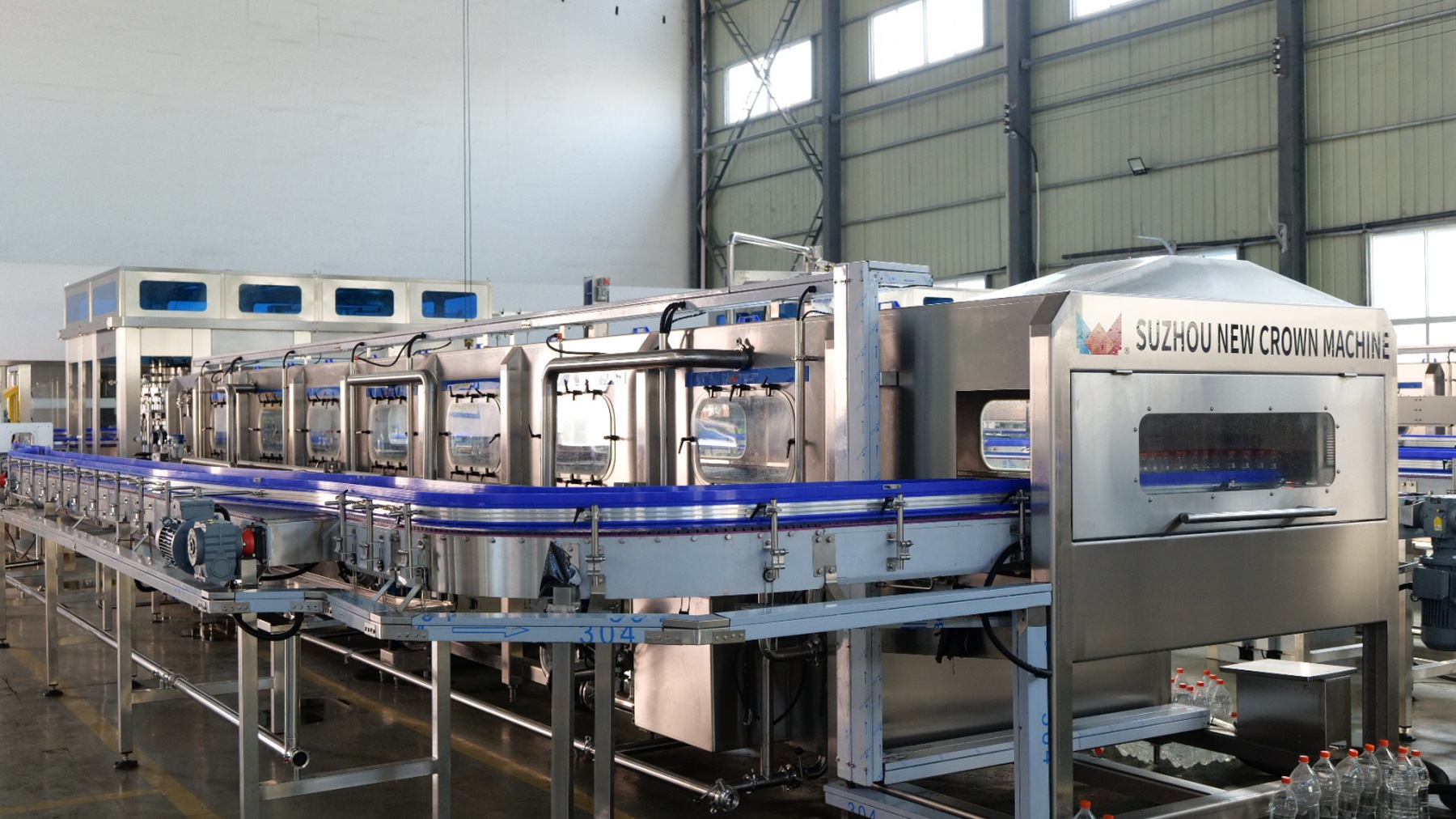
Equipment reference — spray tunnel for post-fill temperature recovery.
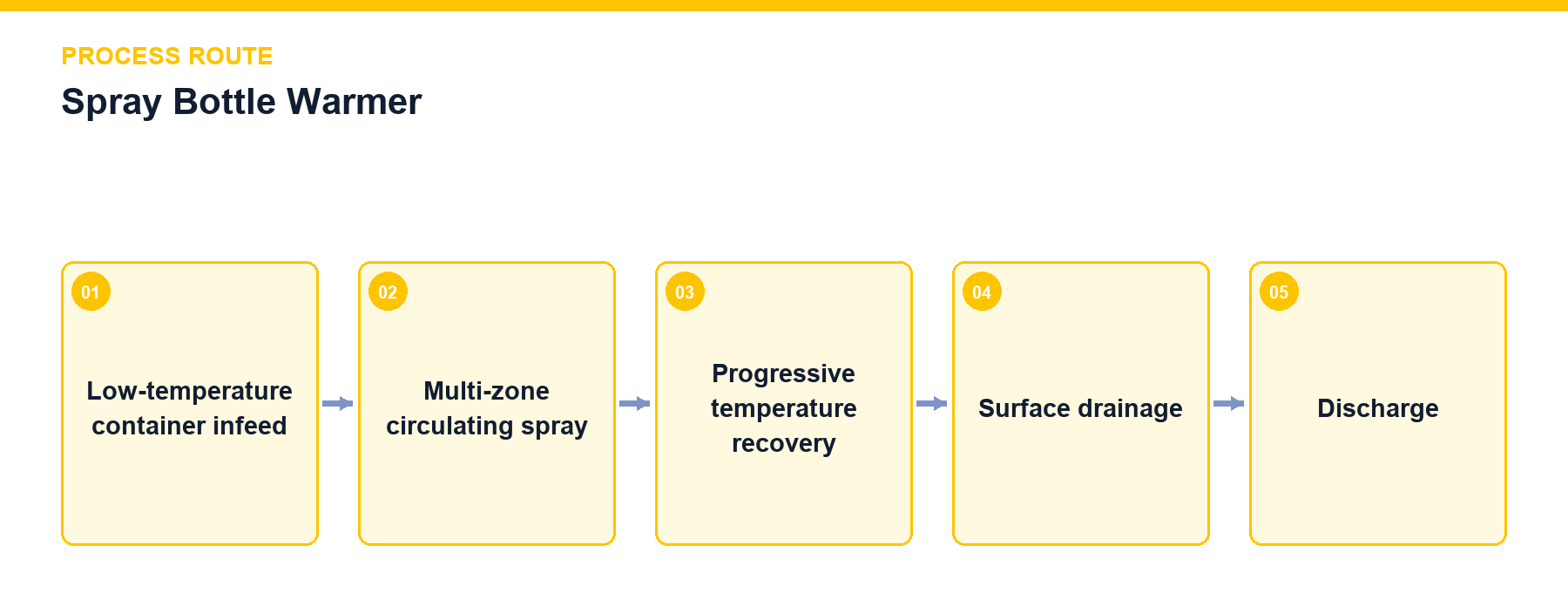
The bottle warmer provides progressive thermal recovery following low-temperature filling. Carbonated beverages leave filling machines at low temperatures, creating heavy condensation upon entering warm, high-humidity ambient environments, which disrupts subsequent drying, labeling, coding, and film wrapping. The system utilizes zoned spraying and circulating water heat exchange: low-temperature finished containers travel on plastic chains at controlled speeds through thermal zones where spray water exchanges heat with container walls before returning to water tanks for temperature regulation, filtration, and repumping. Infeed temperature, exit targets, line speed, and equipment length determine residence time, while multi-zone water temperatures form controlled thermal gradients to prevent excessive surface temperature differentials.
Scroll horizontally to see all table columns.
| Design Object | Technical Description |
|---|---|
| Zoned Spraying | Spray zones, return lines, and circulating water tanks arranged according to progressive heating gradients. |
| Circulating Water System | Water pumps, filters, spray nozzles, and tank level controls maintaining continuous spray coverage. |
| Temperature Regulation | Heat exchange interfaces, make-up water valves, and temperature control valves maintaining zone water temperatures. |
| Residence Time | Determined by effective chain length and transport speed, verified against actual thermal loads. |
| Container Stability | Guide rails, slat chains, and turning radii adapted to wet bottles and various container shapes. |
| Post-Line Drying | Container drainage and air-drying integration following warm discharge to minimize surface moisture. |
Scroll horizontally to see all table columns.
| Component | Function |
|---|---|
| Infeed and Discharge Conveyors | Transport sealed containers through thermal zones at defined residence times. |
| Zoned Spray Chambers | Distribute circulating water evenly across container surfaces. |
| Circulating Water Tanks and Pumps | Collect and recirculate spray water for each zone. |
| Spray Nozzles and Filtration | Maintain spray distribution and reduce nozzle clogging. |
| Heat Exchange Interfaces and Controls | Regulate zone water temperatures and heating gradients. |
Operation and control encompass zone water temperature control, circulating water tank level and water pump protection, transport speed and residence time control, spray pressure or flow monitoring, and upstream/downstream bottle-jam interlocking.
Cleaning and maintenance require regular blowdown, cleaning, and clog inspection for circulating water tanks, filters, and spray nozzles, ensuring drainage and cleaning accessibility for wet-zone chains, guides, and equipment bases, and conducting daily inspections of temperature sensors and circulating pump status.
Scroll horizontally to see all table columns.
| Input Parameter | Description |
|---|---|
| Thermal Range | Infeed and target exit temperatures. |
| Product & Line Speed | Product thermal load, container volume, and target bottle speed. |
| Utilities & Footprint | Available thermal/cooling utilities, allowable equipment length, and wastewater conditions. |
Project reference only — not a standard specification.
Scroll horizontally to see all table columns.
| Project Description | Configuration / Parameter | Use Boundary |
|---|---|---|
| 10,000 BPH, 330 mL PET CSD Line | Product temperature input approx. 0–5°C, exit approx. 25–30°C | Project Operating Condition |
| 10,000 BPH, 330 mL PET CSD Line | Two-zone spray temperature regulation, approx. 15 min residence time | Project Configuration |
| 48,000 BPH, 330 mL PET CSD Line | System interfaces including circulating water, spray zones, heat/cold utility connections, plastic chains, and speed control | High-Speed Project Structure |
| 48,000 BPH, 330 mL PET CSD Line | Three-zone thermal gradient, entry 5°C, exit 25–30°C, approx. 40 min residence time | Project Operating Condition |
| 48,000 BPH, 330 mL PET CSD Line | Three approx. 500 L water tanks, spray pumps, 20-tonne cooling water tank, and recommended 40–50 HP chiller unit | Project Engineering Record |
A bottle warmer provides project-defined temperature transition after filling. In the documented CSD reference, the system used a two-zone spray route with a product-temperature transition from approximately 0–5°C at entry to approximately 25–30°C at exit.
Zone count and thermal gradients are engineered based on specific line speeds and thermal loads; adding zones requires proper thermal gradient design to avoid excessive surface temperature differentials on PET containers.
Consult our process engineering team to design a thermal conditioning bottle warmer matched to your carbonated beverage line throughput and operating conditions.
Discuss your project