Application scope
- The application scope covers PET bottle film packaging, tray-supported or trayless container bundles, and other container combinations confirmed for dimensions and heat resistance.

Secondary Packaging and End of Line
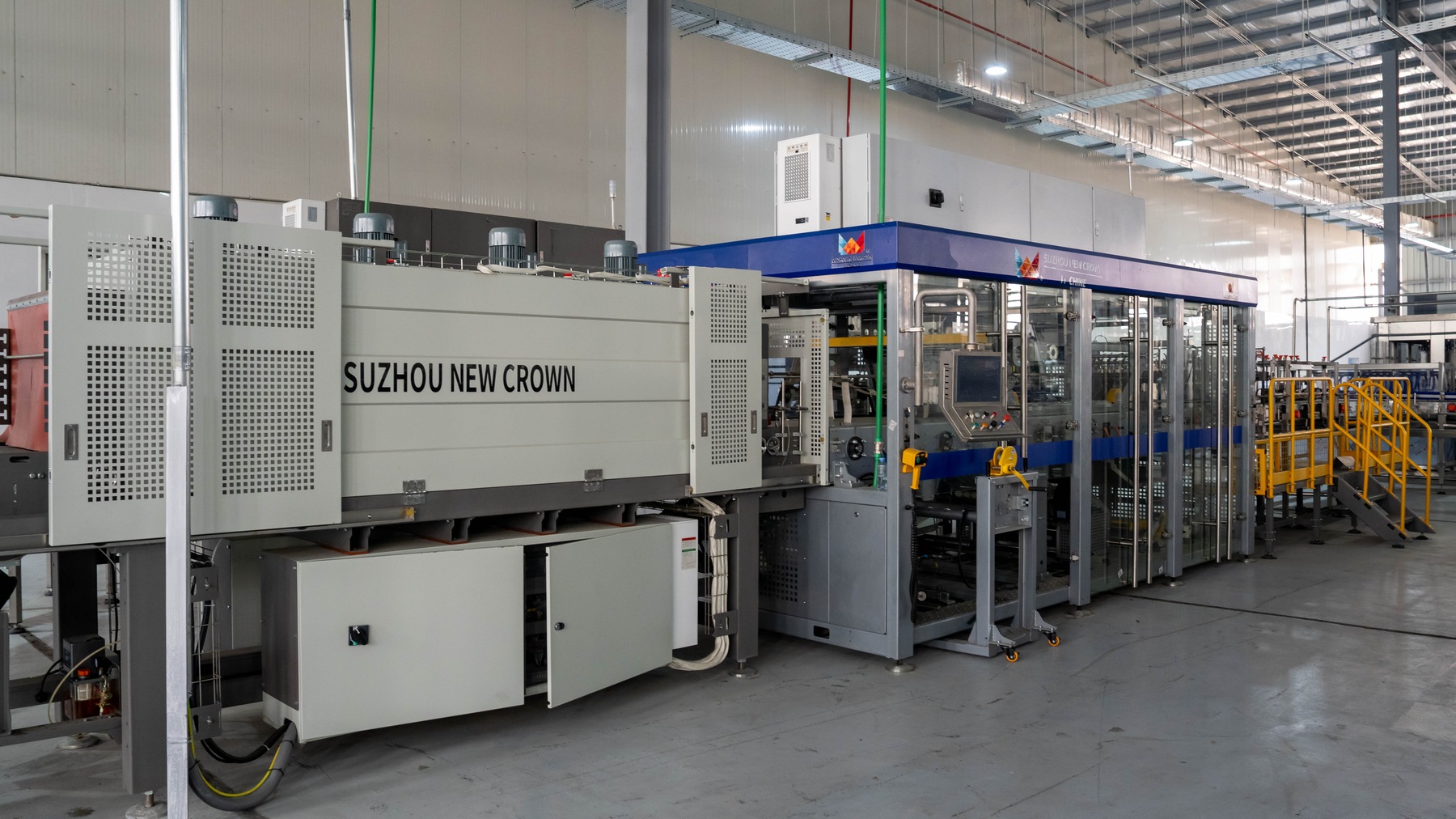
The heat shrink film packaging machine groups individual beverage containers into defined arrays, wraps them in plastic film, and passes them through a thermal shrink tunnel to form stable secondary bundles.
Project fit snapshot
Suitability depends on the product, container, output, hygienic route and connected equipment. Conditions outside the published scope require engineering review.
Technical content: fourth editionProject records shown below are project-specific references, not standard specifications.
The heat shrink film packaging machine groups individual beverage containers into defined arrays, wraps them in plastic film, and passes them through a thermal shrink tunnel to form stable secondary bundles.
Project reference — heat shrink film packaging machine.
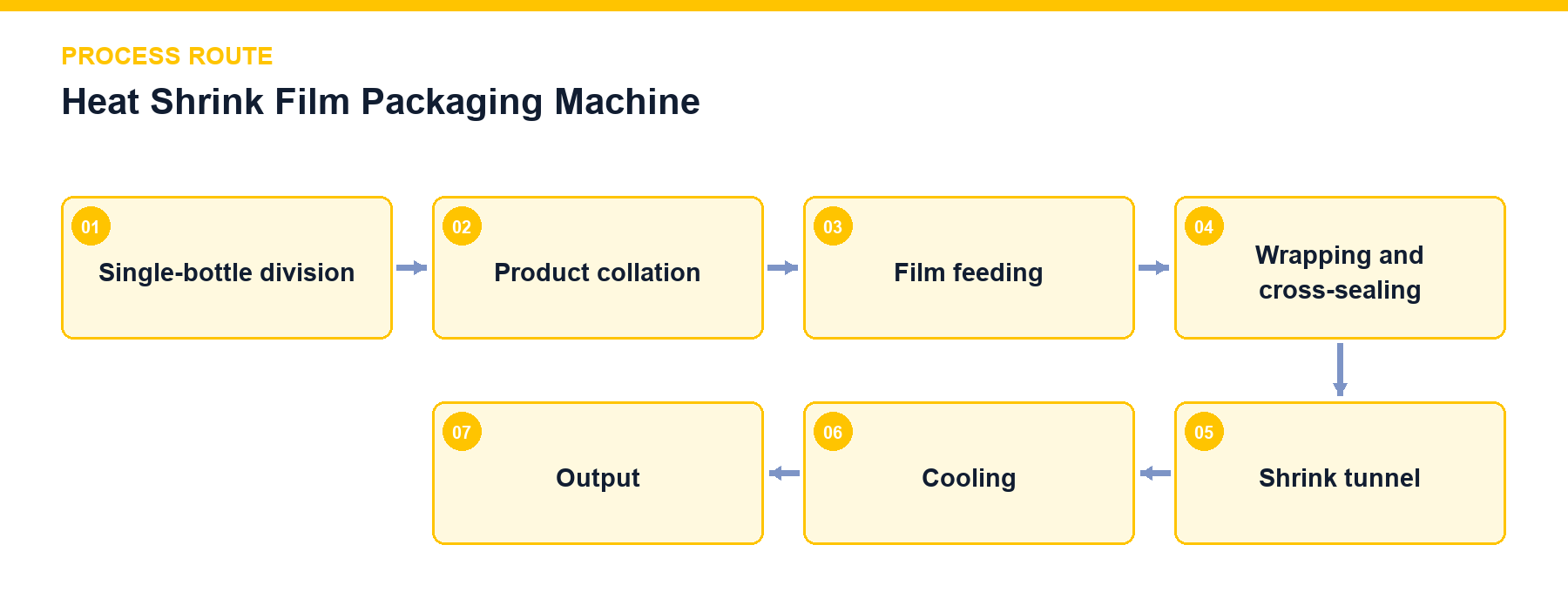
The heat shrink packaging machine converts continuous single bottles into transportable and palletizable packaging units. Incoming bottles undergo division, collation, and counting to form container groups. Film is fed to length, wraps the product, undergoes cross-sealing, passes through the shrink tunnel, and exits via cooling conveyors for stabilization. Bundle stability is governed by bottle arrangement, film width/thickness, feed tension, sealing status, tunnel temperature, airflow, and transport speed. Lightweight PET containers deform more easily under heat and pressure, requiring shrinkage parameters to be coordinated with container heat resistance and product temperature.
Scroll horizontally to see all table columns.
| Design Object | Technical Description |
|---|---|
| Division and Collation | Organizing continuous bottle flow into required rows and columns with controlled spacing and quantities. |
| Film Feeding | Continuous roll film unwinding with tension, skew control, and low-reel detection. |
| Wrapping and Sealing | Film placement, cutting, and cross-sealing executed as container groups pass through. |
| Shrink Tunnel | Zoned hot-air circulation shrinking film tightly around container groups. |
| Exit Cooling | Film stabilization and package cooling prior to conveying and palletization. |
| Multi-Lane Capability | High-speed projects utilizing dual-lane or multi-channel configurations to share packaging throughput. |
Scroll horizontally to see all table columns.
| Component | Function |
|---|---|
| Division and Collation Units | Organize single bottles into defined matrix arrays. |
| Film Feed and Tension Systems | Supply roll film at stable lengths. |
| Sealing Mechanisms | Execute film wrapping, cutting, and edge sealing. |
| Heat Shrink Tunnel | Utilize controlled hot air to shrink film onto container groups. |
| Exit Cooling and Conveying Units | Stabilize newly shrunk packages for downstream transfer. |
Operation and control encompass bottle quantity and grouping verification, film feed length and low-reel detection, sealing temperature and operational status control, shrink tunnel temperature zone control, and downstream bundle-jam interlocking.
Cleaning and maintenance require regular cleaning and inspection of sealing blades, feed rollers, tunnel chains, and air ducts, controlled machine stoppage for film roll replacement and break clearing, and format changeover verification of lane guides, film feed length, shrink temperature, and palletizer compatibility.
Scroll horizontally to see all table columns.
| Input Parameter | Description |
|---|---|
| Container Specs | Bottle shape, single-bottle weight, and heat resistance. |
| Arrangement & Speed | Bundle matrix arrangement, tray requirements, and target bundle speed. |
| Film & Output | Film material and thickness, shrink appearance, and downstream palletizing method. |
Project reference only — not a standard specification.
Scroll horizontally to see all table columns.
| Project Description | Configuration / Parameter | Use Boundary |
|---|---|---|
| 10,000 BPH, 330 mL PET CSD Line | Packaging capacity single-lane 15 PPM | Project Configuration |
| 10,000 BPH, 330 mL PET CSD Line | Roll film record max width 900 mm, thickness 0.06–0.12 mm | Package Specification Verification |
| 48,000 BPH, 330 mL PET CSD Line | High-speed dual-lane packaging 2×40 PPM, total 80 PPM | Project Configuration |
| 5,000 BPH, 500 mL PET Juice Hot-Fill Line | Packaging machine WD-150A; 8–12 bundles/min; max package approx. 600×400×350 mm | Project Equipment Record |
| 5,000 BPH, 500 mL PET Juice Hot-Fill Line | Film materials PE/PVC/POF, thickness 0.03–0.15 mm; recorded tunnel temperature range 160–260°C | Project Equipment Scope |
| 48,000 BPH, 330 mL PET CSD Line | Dual-lane film packaging 2×40 bundles/min, total 80 bundles/min | Project Configuration |
| 48,000 BPH, 330 mL PET CSD Line | Film width max 900 mm, thickness 0.06–0.12 mm; recorded tunnel temperature range 200–280°C | Project Equipment Scope |
| 48,000 BPH, 330 mL PET CSD Line | Main drive approx. 35 kW, shrink oven approx. 105 kW, dimensions approx. 17,421×2,800×3,100 mm | Project Equipment Record |
Shrink tunnel temperatures, airflow volumes, and conveyor speeds are strictly coordinated to achieve tight film wrapping without deforming lightweight PET containers.
Yes. Format changeovers adjust lane guides, film feed lengths, and recipe parameters to accommodate various bundle matrix counts.
Contact our packaging specialists to configure a high-efficiency heat shrink film packer matched to your required bundle speed and format matrix.
Discuss your project