Application scope
- The application scope encompasses PET bottles, glass bottles, and other round or shaped containers verified through sample testing.

Secondary Packaging and End of Line
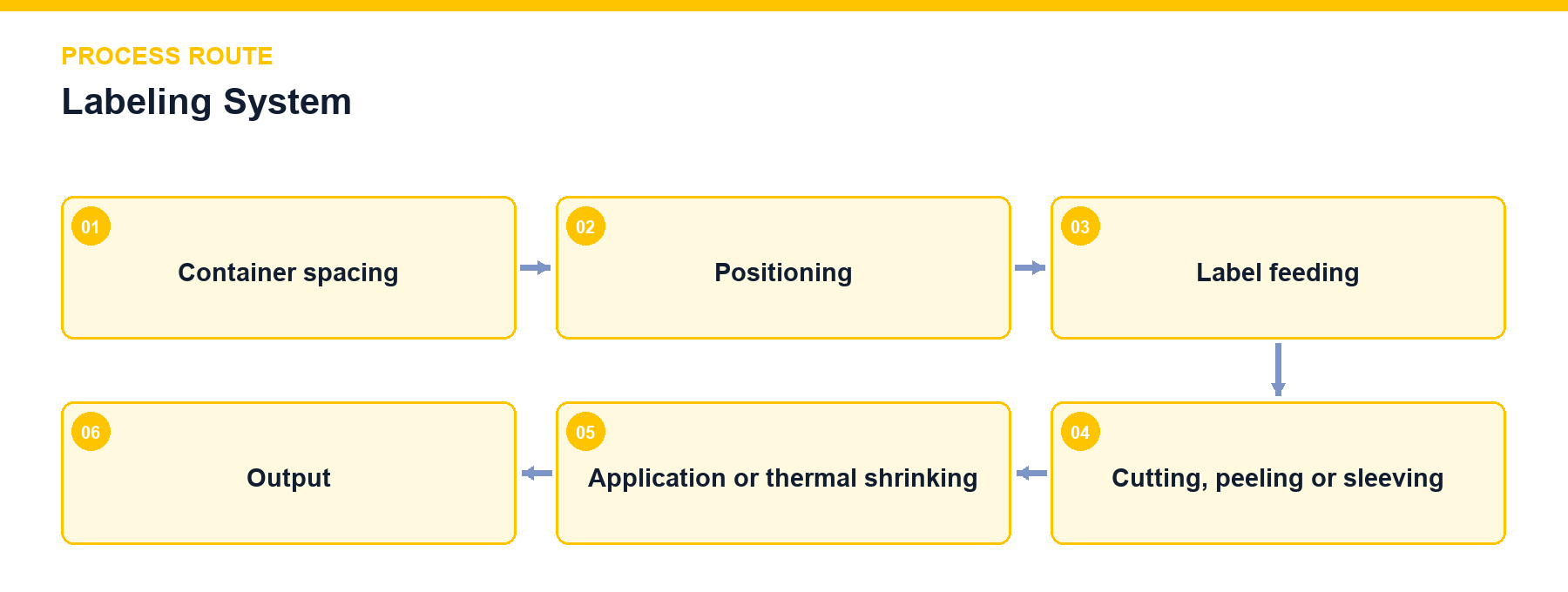
The labeling system applies precision identification, branding, and regulatory information onto beverage containers, supporting OPP hot-melt roll-fed labeling, heat shrink sleeve application, and self-adhesive labeling formats.
Project fit snapshot
Suitability depends on the product, container, output, hygienic route and connected equipment. Conditions outside the published scope require engineering review.
Technical content: fourth editionProject records shown below are project-specific references, not standard specifications.
The labeling system applies precision identification, branding, and regulatory information onto beverage containers, supporting OPP hot-melt roll-fed labeling, heat shrink sleeve application, and self-adhesive labeling formats.
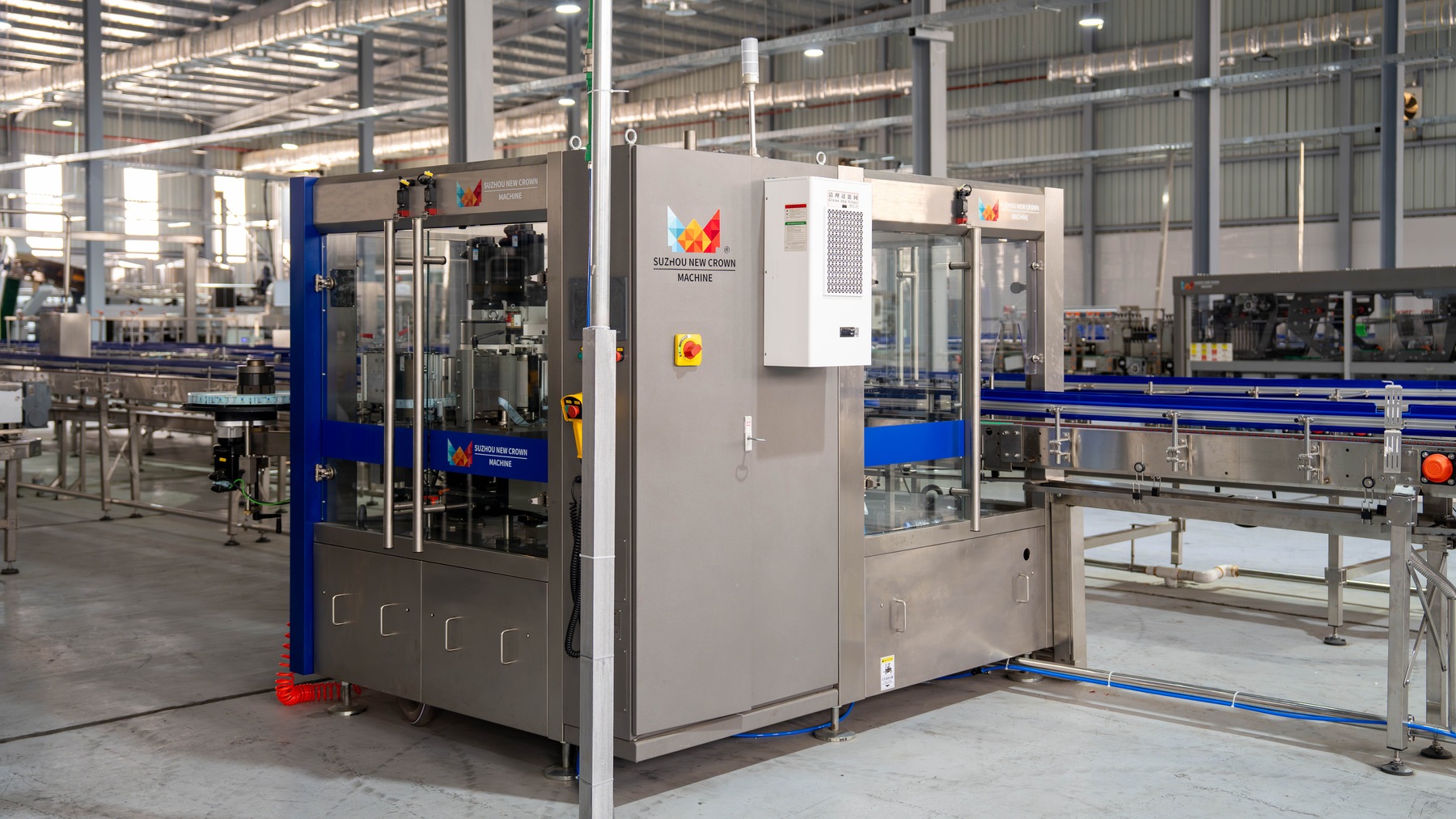
Project reference — automatic labeling machine.
The labeling system integrates container positioning, web handling, label forming, and application into a continuous process. Typical projects cover OPP hot-melt wrap-around labeling and heat shrink sleeve application, incorporating web tension control, guiding, feeding, cutting, gluing, missing-label detection, and break detection. OPP labelers feed roll film with constant tension and guiding, cutting labels and applying hot-melt glue to leading and trailing edges before wrapping containers. Sleeve labelers cut tubular labels, apply them to designated positions, and shrink them via steam or hot-air tunnels. Laser coding operates as an adjacent identification station triggered by container or package sensors.
Scroll horizontally to see all table columns.
| Design Object | Technical Description |
|---|---|
| Container Spacing | Establishing stable single-container pitch and labeling baselines to reduce line fluctuations. |
| Web Handling | Reel supply, constant tension, and guiding mechanisms controlling label skew and tension. |
| Feeding and Cutting | Servo label feeding synchronized with bottle flow, with cutting or peeling units delivering individual labels. |
| Gluing and Application | OPP application applying glue to leading/trailing edges with temperature, glue volume, and roller status control. |
| Sleeving and Shrinking | Sleeve placement combined with steam or hot-air tunnel temperature distribution determining exterior appearance. |
| Inspection Interlocks | No-bottle no-label, low-reel, break, missing-label, and position error alarms or stops. |
| Laser Coding | Coding trigger, recipe management, focal distance, and line speed matching material requirements. |
Scroll horizontally to see all table columns.
| Component | Function |
|---|---|
| Container Spacing and Positioning Units | Establish stable pitch and labeling baselines. |
| Label Supply and Tension Mechanisms | Continuously feed roll stock and control skew. |
| Labeling Application Mechanisms | Execute sleeve, hot-melt, or self-adhesive transfer. |
| Shrinking or Press-On Units | Ensure stable adhesion to container contours. |
| Detection and Ejection Units | Identify missing labels, breaks, and positional defects. |
Operation and control encompass missing-bottle and label feeding interlocks, label tension and guiding control, break, missing-label, and low-reel detection, container positioning and coding triggers, and controlled labeling stoppage during downstream congestion.
Before labeling and coding, the bottle surface condition is coordinated with the upstream drying or temperature-treatment route. Cleaning and maintenance cover the project-defined label feeding, cutting, gluing, application, detection and coding components.
Scroll horizontally to see all table columns.
| Input Parameter | Description |
|---|---|
| Container Specifications | Material, dimensions, shape, and positioning features. |
| Label Parameters | Material, dimensions, layout format, and roll core specs. |
| Speed & Accuracy | Target line speed, placement accuracy tolerance, and surface temperature. |
Project reference only — not a standard specification.
Scroll horizontally to see all table columns.
| Project Description | Configuration / Parameter | Use Boundary |
|---|---|---|
| 10,000 BPH, 300 mL PET Water Line | OPP hot-melt labeler model NC-OL-1, 8,000–12,000 BPH capacity range | Project Configuration |
| 10,000 BPH, 330 mL PET CSD Line | OPP labeler featuring 15 bottle stars, 1 labeling station, roller gluing, single wrap-around label | Project Equipment Table |
| 10,000 BPH, 330 mL PET CSD Line | Label thickness 0.04–0.05 mm | Project Verification |
| 5,000 BPH, 500 mL PET Hot-Fill Line | Process sequence including drying, sleeving, laser coding, and film wrapping | Project Flow |
| 10,000 BPH, 300 mL PET Water Line | OPP wrap-around range 8,000–12,000 BPH, bottle diameter 40–90 mm, label height 40–140 mm | Project Equipment Range |
| 10,000 BPH, 300 mL PET Water Line | Label materials OPP/BOPP/paper, thickness 0.035–0.05 mm | Project Equipment Range |
| 5,000 BPH, 500 mL PET Juice Hot-Fill Line | Sleeve labeling capacity 250 BPM, bottle diameter 25–125 mm, label length 30–250 mm | Project Equipment Range |
| 5,000 BPH, 500 mL PET Juice Hot-Fill Line | Sleeve materials PVC/PET/OPS, thickness 0.03–0.13 mm | Project Equipment Range |
| 10,000 BPH, 330 mL PET CSD Line | OPP wrap-around unit SPCTTB.18800, sample round bottle capacity 18,800 BPH | Project Equipment Record |
| 48,000 BPH, 330 mL PET CSD Line | Two OPP wrap-around units SPCTTB.28800, single unit capacity 28,800 BPH | Combined capacity subject to stream division and line speed verification |
Surface moisture on bottles interferes with glue transfer, label positioning, and laser coding quality, making upstream thermal conditioning and air-drying essential.
OPP labeling applies wrap-around film labels using hot-melt glue for cylindrical containers, whereas shrink sleeve labeling applies tubular film that shrinks to fit contoured container bodies via thermal tunnels.
Consult our packaging engineering team to select the optimal labeling technology and machine configuration for your brand presentation requirements.
Discuss your project