Application scope
- The application scope covers shrink film bundle palletizing, corrugated carton palletizing, and multi-format, multi-layer beverage finished goods.

Secondary Packaging and End of Line
The robotic palletizer utilizes articulated industrial robots and specialized grippers to stack film-wrapped bundles, corrugated cartons, or other packaging units onto pallets according to programmed layer patterns.
Project fit snapshot
Suitability depends on the product, container, output, hygienic route and connected equipment. Conditions outside the published scope require engineering review.
Technical content: fourth editionProject records shown below are project-specific references, not standard specifications.
The robotic palletizer utilizes articulated industrial robots and specialized grippers to stack film-wrapped bundles, corrugated cartons, or other packaging units onto pallets according to programmed layer patterns.
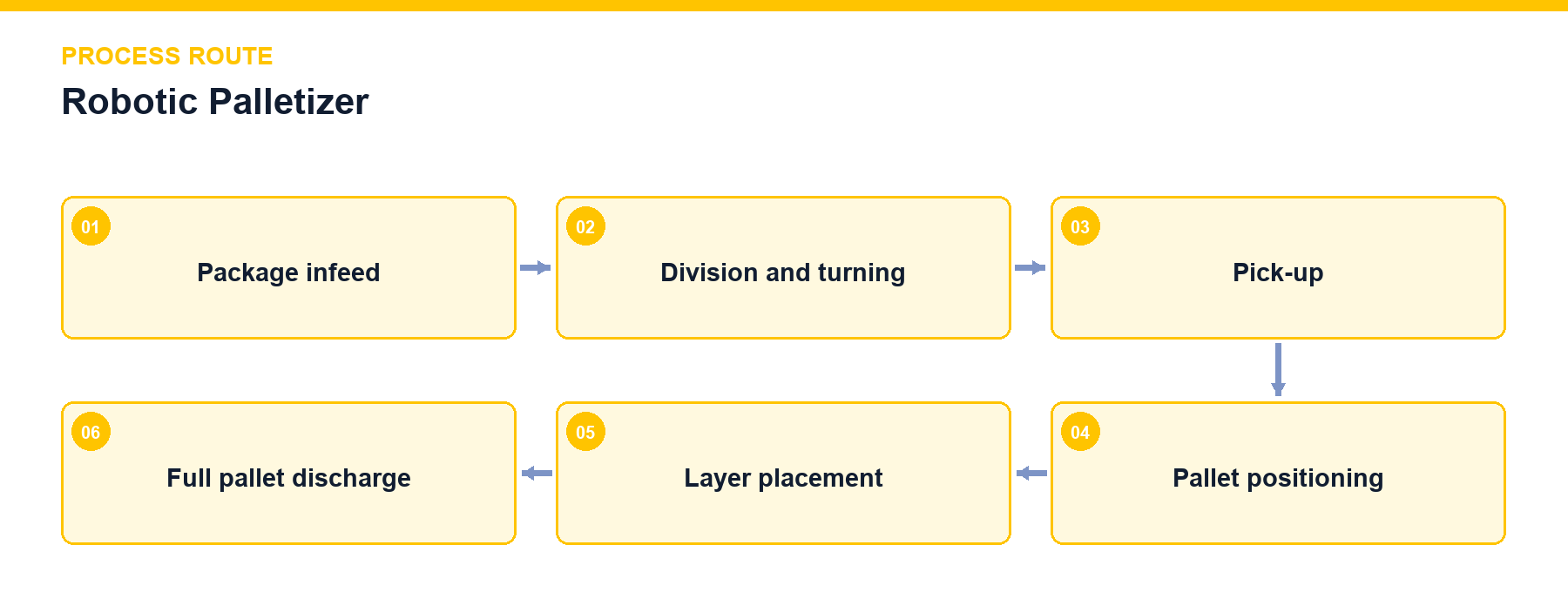
The robotic palletizing system integrates package transport, pallet handling, and slip sheet insertion into a single safety cell. Packages undergo division, turning, and spacing on infeed conveyors, while robots pick single units, complete rows, or full layers based on active layer patterns and place them onto positioned pallets. Layer recipes manage orientation, count, interlocking, and slip sheet placement, while gripper structures are matched to package dimensions, weights, and surface strengths. Infeed spacing, orientation, and package strength must remain consistent, as variations disrupt stack geometry despite stable robot repeatability.
Scroll horizontally to see all table columns.
| Design Object | Technical Description |
|---|---|
| Infeed Collation | Forming single units, rows, or full layers via division, stopping, and turning mechanisms. |
| Gripper Design | Clamping, lifting, vacuum, or hybrid structures selected according to packaging format. |
| Layer Recipe Management | Programming layer counts, orientations, shifting, and interlayer slip sheet insertion. |
| Pallet Supply | Automated empty pallet separation, transport, positioning, and full pallet discharge interlocked with robot operation. |
| Safety Cell | Perimeter fencing, door locks, emergency stops, and access control restricting automatic robot motion. |
| Downstream Handoff | Transferring completed pallets to stretch wrappers, conveyors, or forklift pickup stations. |
Scroll horizontally to see all table columns.
| Component | Function |
|---|---|
| Infeed Collation System | Establishes single units, rows, or full layers for picking. |
| Articulated Robot Arm | Executes pick, transfer, and stacking trajectories. |
| Palletizer Gripping Tooling | Carries products based on package material and pick count. |
| Empty Pallet Supply and Positioning Unit | Holds pallets at stacking datums. |
| Safety Enclosure and Discharge System | Isolates motion zones and transfers finished pallets. |
Operation and control encompass package presence and pick-permission interlocks, gripper status verification, pallet presence and positioning detection, layer recipe and tier count management, and safety door locks/operator access protocols.
Cleaning and maintenance require maintaining gripper contact parts, vacuum components, and positioning sensors based on dust and wear, verifying stacking center-of-gravity, trajectory, stack geometry, and pallet load after format changeovers, and executing safety stops and energy isolation prior to personnel entry into safety enclosures.
Scroll horizontally to see all table columns.
| Input Parameter | Description |
|---|---|
| Package Specs | Dimensions, weight, quantity per layer, and package type. |
| Pallet & Speed | Pallet dimensions, target package speed, stack height, and layer patterns. |
| Slip Sheets & Changeover | Interlayer slip sheet requirements, gripper format, and changeover needs. |
Project reference only — not a standard specification.
Scroll horizontally to see all table columns.
| Project Description | Configuration / Parameter | Use Boundary |
|---|---|---|
| 10,000 BPH, 330 mL PET CSD Line | Shrink film bundle automatic palletizing handed off to pallet stretch wrapping | Project Process Flow |
| 48,000 BPH, 330 mL PET CSD Line | Palletizing capacity recorded at 30–40 bundles/min | Project Package and Layer Conditions |
| 48,000 BPH, 330 mL PET CSD Line | Single layer load max 250 kg; full pallet max 1,500 kg; stack height max 1,800 mm | Project Equipment Record |
| 48,000 BPH, 330 mL PET CSD Line | Utility power approx. 20 kW; pneumatic supply 7 bar, approx. 700 L/min | Project Equipment Record |
Layer recipes are selected via the HMI, automatically coordinating robot placement coordinates, bundle orientations, and interlayer slip sheet insertion.
Gripper selection depends on line speed, package weight, bundle format, and stacking pattern requirements specified during project engineering.
Contact our end-line automation specialists to select the ideal robotic palletizing system for your throughput, footprint, and stability requirements.
Discuss your project